
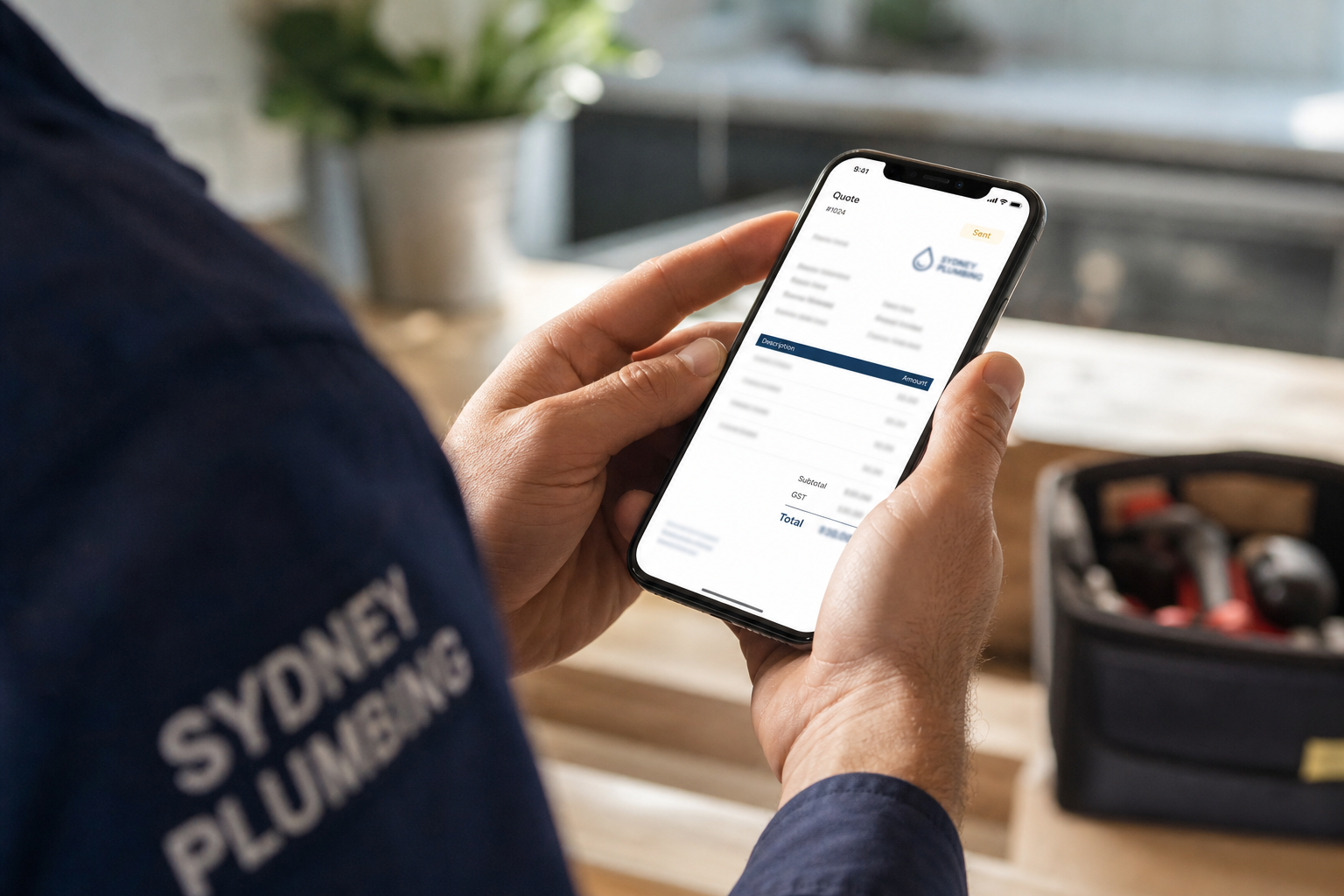
After-hours plumbing pricing in Sydney varies enormously between operators. We’ve seen quotes for the same work — a flexi-hose replacement at 9pm on a Sunday — that range from $280 (our standard emergency rate) to $1,250 (a competitor with a 4x weekend loading and a $250 callout layered on top).
Both quotes are legal. Neither is regulated by anyone. The difference reflects business model choices and whether the operator views after-hours emergencies as a service or as a revenue maximisation opportunity.
This guide covers what fair after-hours pricing looks like in Sydney in 2026, what the various premium structures actually cost in practice, and how to distinguish between reasonable loading and outright price-gouging. For full 2026 rate tables, see our Sydney emergency plumber pricing guide.
The fundamental distinction
The first principle that separates honest from opportunistic operators is the distinction between two types of after-hours work:
Genuine emergency. The situation cannot reasonably wait until business hours. Examples: burst pipe repair Sydney actively flooding, gas leak emergency Sydney, sewage backing up into living areas, no hot water with elderly residents or infants in the home, no functioning toilets in a single-bathroom household.
After-hours convenience. The work could reasonably wait until business hours, but the customer prefers earlier service. Examples: a slow drip from a tap, a slow drain, a non-urgent fixture replacement, a slightly low water pressure issue.
Reputable Sydney operators charge differently for the two categories:
- Genuine emergencies: standard emergency rate any hour, any day. Same Tuesday-morning rate at 3am Sunday.
- After-hours convenience: premium hourly rate (typically $180-300/hr) reflecting that the customer is paying for scheduling preference rather than urgency.
Less reputable operators don’t make the distinction — every call after 6pm gets the premium rate regardless of urgency.
Why reputable operators can hold standard rates for emergencies
The structural reason: rostered overnight staff on shift loadings have a relatively flat cost profile across the 24-hour cycle. A plumber on a 4-day-on-3-day-off rotation with overnight shifts at 25% loading is materially cheaper to deploy at 3am than a freelance contractor responding to a per-call dispatch.
A company that genuinely runs 24/7 operations with rostered crews can absorb the after-hours cost variance and maintain relatively even pricing. A company that “advertises” 24/7 but relies on freelance contractors at premium rates has to pass those costs on — typically by charging customers double or triple the daytime rate.
The customer experience tells you which model the operator runs. Calls answered by a live dispatcher with a fast plumber arrival typically indicate rostered operations. Calls going to voicemail with delayed callbacks typically indicate freelance backup arrangements.
Common after-hours premium structures
What you’re likely to encounter from Sydney operators:
Single rate (premium charged for everything after-hours)
Some operators apply a flat 50-100% loading to all work performed outside business hours, regardless of urgency or duration.
Example: Standard rate $130/hr → after-hours rate $260/hr
Implication: A 60-minute burst pipe repair that would cost $130 + $80 parts = $210 during business hours costs $260 + $80 = $340 at 11pm.
Reasonable for: Non-urgent convenience bookings.
Not reasonable for: Genuine emergencies, where the same operator running rostered crews could maintain standard rates.
Tiered rates (different premiums for different times)
Other operators have multiple tiers:
- Standard rate (Mon-Fri 7am-5pm)
- Evening rate (5pm-9pm + Saturday 7am-12pm) — typically +30-50%
- Late evening rate (9pm-11pm + Saturday afternoon) — typically +75-100%
- Overnight rate (11pm-7am + Sundays + public holidays) — typically +100-200%
Implication: Same 60-minute burst pipe repair could cost anywhere from $210 to $570 depending on exact dispatch time.
Reasonable approach if the operator distinguishes between urgency types and applies these rates only to convenience bookings. Unreasonable if applied to genuine emergencies where the customer has no flexibility about timing.
Flat callout fees
Some operators charge:
- $0 callout, $130/hr business hours
- $80-200 callout, $130/hr after-hours
Implication: Adds a fixed cost to short jobs. A 30-minute flexi-hose replacement at 11pm costs $65 (half hour) + $150 (callout) + $80 (parts) = $295.
Reasonable approach if the callout is genuinely covering travel + dispatcher cost; unreasonable if it’s effectively a hidden price increase.
Single flat rate for genuine emergencies (our model)
Standard emergency rate any hour, any day, for genuine emergency work. After-hours premium reserved exclusively for convenience-scheduled non-urgent work.
Example: Standard rate $130/hr applies whether the burst pipe call comes in Tuesday 10am or Sunday 3am. After-hours premium rate $220/hr applies to Sunday-evening tap repair the customer requested at 8pm rather than waiting until Monday.
Implication: Predictable pricing for emergencies; no incentive for the operator to misclassify urgency to maximise rates.
What to ask before agreeing to after-hours dispatch
Three questions to clarify pricing before booking:
“What rate applies if I’m dispatching now?” Reputable operators give you a specific number, not a range or “we’ll work it out on arrival.”
“Does that rate change if the work takes longer than the first hour?” Some operators load the first hour and reduce subsequent hours; others maintain a flat rate. Either is fine if disclosed; evasiveness is the problem.
“Is there a separate callout fee on top of the hourly rate?” Get a yes/no answer. If yes, get the dollar amount.
If any answer involves “we’ll work that out on arrival” or “depends on what we find,” that’s a meaningful warning sign. Walk away.
What to do if you’ve been overcharged
If you’ve already engaged a plumber and the final invoice is substantially higher than what was quoted (or what you’d consider reasonable):
Step 1: Don’t pay anything you don’t agree to. You’re not legally obligated to pay an invoice that doesn’t match what was quoted in writing.
Step 2: Ask for itemisation. Reputable operators provide itemised invoices showing labour, parts, and any other charges separately. Vague invoices are negotiable.
Step 3: Negotiate. Genuine misunderstandings about scope or duration can usually be resolved at half the disputed amount.
Step 4: If unresolved, complain to NSW Fair Trading. Online at nswfairtrading.gov.au. They can mediate disputes between consumers and licensed contractors.
Step 5: Consider NCAT. NSW Civil and Administrative Tribunal handles disputes under $40,000 without lawyer involvement. Filing fee is modest.
In our experience, reputable Sydney operators rarely face billing disputes because their pricing is transparent in writing before work begins. Disputes typically arise with operators whose pricing structure is deliberately opaque.
Honest answer on what after-hours costs us to deliver
Some transparency on the cost structure for context:
A rostered overnight plumber on shift in Sydney costs us roughly $95-110/hr in fully-loaded labour cost (base wage + super + shift loading + insurances + vehicle + parts inventory allocation). That’s our internal cost to have a competent plumber available at 3am.
We charge $130-160/hr. The margin covers dispatch operations (live overnight dispatcher), management overheads, customer service, and reasonable profit. Standard small-business margins.
Operators charging $300+/hr for genuine emergencies are charging roughly 3x our cost structure. The economics suggest either significantly higher cost structures (freelance dispatch model) or significantly higher profit margins.
Sydney suburbs where after-hours pricing varies most
A few patterns we’ve observed in competitor pricing across the metro:
Inner-ring suburbs (CBD, Surry Hills, Newtown, Bondi): Highest after-hours premium loadings — competitors often quote 2x to 3x daytime rates for convenience-priced operators.
Western Sydney (Penrith, Liverpool, Blacktown): More even pricing across competitors — more cost-conscious customer base keeps pricing competitive.
North Shore (Mosman, Chatswood, Hornsby): Mixed — some high-end operators charging premium rates, some competitive operators maintaining flat pricing.
Northern Beaches (Manly, Mona Vale, Avalon): Long-standing local operators tend to be competitive; new entrants sometimes price-gouge during summer holiday season when demand spikes.
The general rule: pricing competitiveness correlates with operator reputation and operational maturity. The cheapest isn’t necessarily the best, but the most expensive is rarely the most reliable.
Final word
Sydney emergency plumbing pricing varies enormously and there’s no regulator setting standards. The market is genuinely caveat-emptor.
The two most useful decisions you can make:
- Establish a relationship with a reputable operator before you need emergency service. Save the number. Verify licensing during business hours when you have time. Use them for non-urgent work to establish the relationship.
- Get pricing in writing before agreeing to any after-hours dispatch. Take the 30 seconds to confirm the rate, the callout fee structure, and any premium loading. Disagreements resolved in writing before work are easier than disputes resolved after.
The after-hours pricing variation in Sydney is a genuine market problem — but customers have power if they ask the right questions before booking. Our 24 hour emergency plumber Sydney holds the same rate any hour — get a quote before you’re in an emergency.