
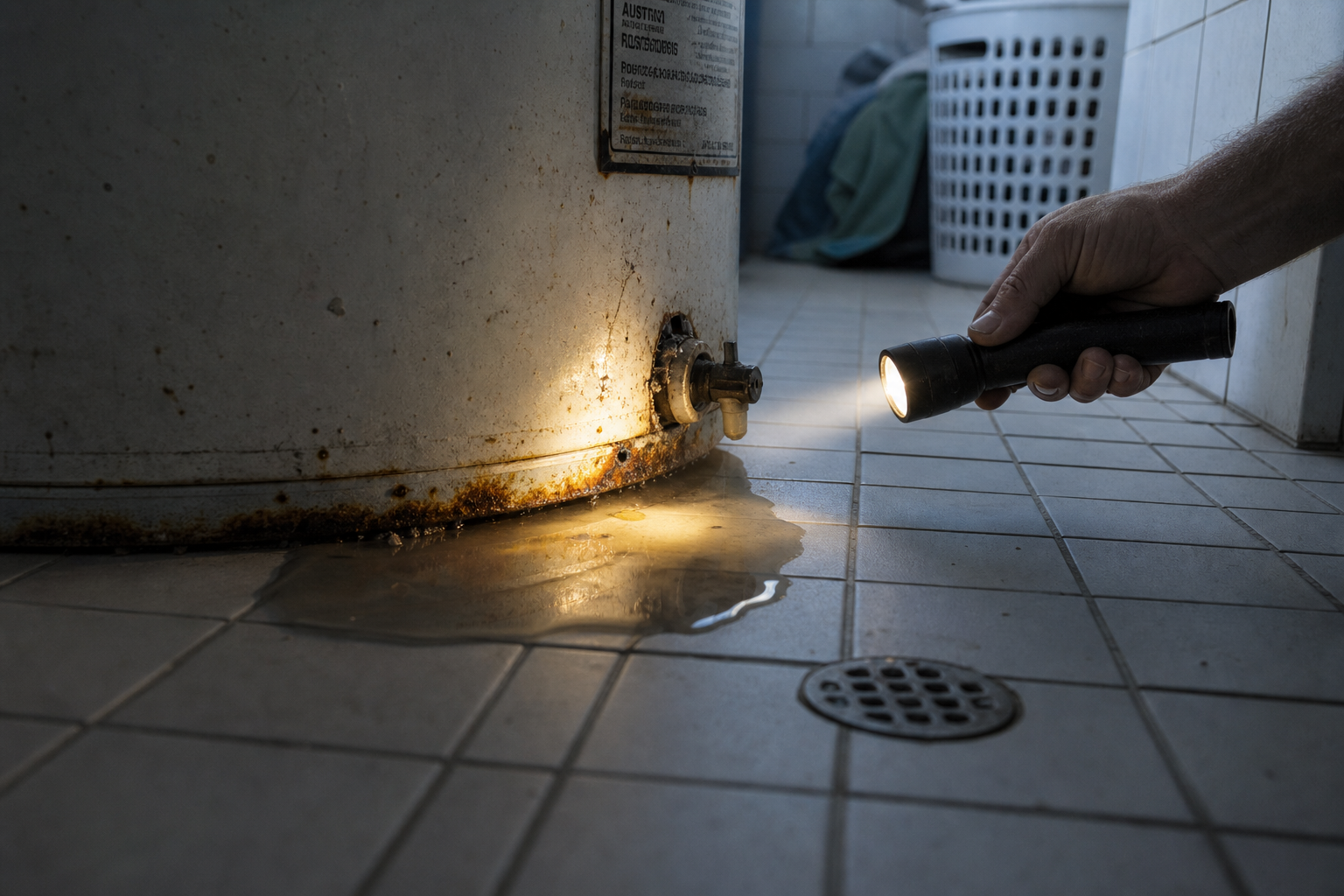
Hot water failures rank among the most frequent emergency plumbing call-outs across the Sydney metro, second only to burst pipes. They tend to fail at the worst possible moments — mid-shower in winter, during the morning rush, just before guests arrive.
The good news: hot water failures fall into predictable patterns by unit type. Most are diagnosable in 15 minutes and repairable same-day. The cost varies enormously based on whether the unit needs a single-component repair or full replacement.
This guide covers the four main hot water unit types in Sydney homes, the typical failure modes for each, and realistic 2026 repair and replacement costs. When you’re ready to act, our emergency hot water repair Sydney team carries common parts for Rheem, Rinnai, Bosch, and Dux units.
The four main hot water unit types in Sydney
The vast majority of Sydney residential hot water installations fall into one of four categories:
Electric storage — most common in older homes and apartments. Insulated tank (typically 80-400 litres) with electric heating elements and thermostats. Reliable, simple, but expensive to run.
Gas storage — common in middle-aged Sydney homes (1980s-2000s builds). Insulated tank heated by a gas burner underneath. Cheaper to run than electric storage but limited efficiency.
Gas instantaneous — increasingly common in newer builds and renovations. No tank — water heated on-demand as it flows through a heat exchanger. Compact, energy-efficient, virtually unlimited supply.
Heat pump — increasingly common as energy efficiency upgrades. Uses ambient heat from the surrounding air to heat water in an insulated tank. Cheapest to run; significant NSW government rebate available.
Each type has characteristic failure modes worth understanding.
Electric storage — common failures
Typical service life: 10-13 years. Common across older Sydney inner-ring apartments and older free-standing homes.
Failure 1: Heating element burnout
The most common electric storage failure. Sacrificial elements (typically copper-sheathed Inconel) burn out after 5-8 years of service. Symptoms:
- No hot water at all (single-element units)
- Reduced hot water capacity, cools faster than expected (dual-element units with one element working)
- Tripped circuit breaker at the meter box
Diagnosis: Multimeter test of element resistance (open circuit indicates burnout). 5-minute check.
Fix: Element replacement, $200-350 including labour. Same-day service in most cases. While the element is being replaced, the sacrificial anode (a separate component preventing tank corrosion) should be inspected and likely replaced.
Failure 2: Thermostat failure
Thermostats fail in two modes — stuck closed (no heating, even when water is cold) or stuck open (water heated to dangerous temperature, relief valve venting steam).
Diagnosis: Voltage and continuity test. 5-minute check.
Fix: Thermostat replacement, $180-300 including labour.
Failure 3: Tank corrosion (terminal failure)
The tank itself rusting through. Always terminal — no economic repair. Symptoms:
- Rust visible at the bottom of the tank
- Water dripping from underneath
- Rust in the hot water at fixtures
Diagnosis: Visual inspection.
Fix: Full unit replacement, $1,200-2,200 depending on capacity and like-for-like vs upgrade.
Failure 4: Sacrificial anode depletion
The anode is a magnesium or aluminium rod that corrodes preferentially to protect the tank. Once depleted (typically 5-7 years), tank corrosion begins. Replacement is preventative, not emergency.
Cost: $180-280 including labour. Worth doing every 5 years to extend tank life.
Gas storage — common failures
Typical service life: 10-12 years. Common in Sydney homes from the 1980s-2000s era.
Failure 1: Pilot light failure
Pilot light goes out and won’t relight. Symptoms:
- No hot water
- Audible clicking from the unit during attempted ignition
- Visible inspection shows pilot is out
Cause: Usually thermocouple failure. The thermocouple is a safety device that detects pilot heat; when it fails, gas supply is shut off as a safety measure.
Diagnosis: Visual inspection plus voltage test of the thermocouple. 10-minute check.
Fix: Thermocouple replacement, $180-280 including labour. Critical: only licensed gasfitters can perform this work in NSW.
Failure 2: Gas valve failure
Main gas valve failure prevents the burner from receiving gas supply. Less common than thermocouple failure but more expensive to repair.
Diagnosis: Pressure test of the valve. 10-15 minutes.
Fix: Gas valve replacement, $350-550 including labour and parts. Compliance certificate issued at completion.
Failure 3: Tank corrosion
Same failure mode as electric storage — once the tank corrodes through, replacement is the only option.
Fix: Replacement gas storage unit, $1,800-3,200 depending on capacity. Many Sydney homeowners use this opportunity to upgrade to heat pump or gas instantaneous.
Failure 4: Burner debris or spider webs
Spiders are surprisingly common cause of gas storage unit failure. Webs in the venturi block air supply, causing incomplete combustion.
Diagnosis: Visual inspection of burner assembly. 5-minute check.
Fix: Burner clean, $150-220 including labour.
Gas instantaneous — common failures
Typical service life: 12-15 years (Rinnai, top of range); 10-12 years (Bosch and entry-level units). Increasingly common across Sydney newer builds.
Failure 1: Failed flame sensor
The flame sensor confirms combustion is occurring; failure prevents the unit from sustaining ignition. Symptoms:
- Unit attempts to fire (audible click and brief flame) but shuts down within 1-2 seconds
- Error code displayed on the unit
- No hot water at any fixture
Diagnosis: Visual inspection plus voltage test. Error code on unit display narrows diagnosis significantly.
Fix: Flame sensor replacement, $250-400 including labour.
Failure 2: Failed gas valve
Less common but more expensive than flame sensor failure.
Fix: Gas valve replacement, $400-650 including labour.
Failure 3: Failed water flow sensor
The water flow sensor detects when a hot tap opens, triggering the unit to fire. Failure prevents the unit from starting even when water demand exists.
Diagnosis: Water flow test, voltage test of the sensor. 10 minutes.
Fix: Flow sensor replacement, $220-380 including labour.
Failure 4: Heat exchanger lime scale
Scale builds up in the heat exchanger over years, particularly in suburbs with hard water. Reduces heat transfer efficiency, eventually causes overheating and unit shutdown.
Diagnosis: Performance test plus visual inspection.
Fix: Descaling, $280-450 including labour. Worth doing preventively every 5-7 years for units in hard-water areas.
Failure 5: Storm-related electronic faults
Outdoor gas instantaneous units exposed to sustained heavy rain sometimes develop sensor or controller faults 24-72 hours after the storm event. Most are minor (sensor replacement) rather than catastrophic.
Fix: Component replacement, $200-450 depending on the specific failure.
Heat pump — common failures
Newer technology in Sydney; service patterns still being established. Typical service life: 10-15 years for the compressor; refrigerant components 5-7 years.
Failure 1: Compressor failure
The compressor is the heart of the heat pump system. When it fails, the unit reverts to electric backup heating (much higher running cost) or stops heating entirely.
Diagnosis: Refrigerant pressure test plus electrical diagnostics.
Fix: Compressor replacement, $800-1,800. Many heat pump manufacturers warrant compressors for 5-7 years; check warranty status before paying for repair.
Failure 2: Failed expansion valve
Less common but disrupts the refrigerant cycle.
Fix: Expansion valve replacement, $400-650.
Failure 3: Refrigerant leak
Slow refrigerant loss reduces heating capacity over months. Eventually requires recharge plus leak repair.
Fix: Leak repair plus recharge, $500-1,200.
Failure 4: Controller fault
Electronic controller failures present as error codes and unit shutdown. Usually replaceable at the board level.
Fix: Controller replacement, $350-700.
Repair vs replace decision
The economics of repair vs replacement vary by unit age and failure type:
- Unit under 8 years old, single component failure: Repair almost always makes sense.
- Unit 8-12 years old, single component failure: Repair usually makes sense, but evaluate the broader unit condition.
- Unit over 12 years old, any failure: Replacement usually makes economic sense — the unit is approaching multiple end-of-life failures.
- Tank corrosion or major structural failure (any age): Replacement only — no economic repair.
- Multiple repairs over a 12-month period: Replacement usually makes economic sense — the unit has moved into the failure cluster phase.
A specific consideration: running cost differences between unit types are now substantial. An old electric storage unit may run $800-1,200/year in electricity; a comparable heat pump may run $200-350/year. The lifetime running cost difference often exceeds the upfront replacement cost.
NSW Energy Savings Scheme rebates
The NSW government provides rebates for hot water system upgrades that reduce energy consumption. As of 2026, typical rebates:
- Electric to heat pump: $700-1,500 depending on unit and household size
- Gas to heat pump: $300-800
- Inefficient gas to high-efficiency gas: $200-400
Rebates are processed through accredited installers. We handle the paperwork as standard with every eligible upgrade install.
Sydney suburb-specific considerations
A few patterns we see across the metro:
Eastern Suburbs and Northern Beaches (salt-air zones): Outdoor unit cladding corrosion accelerates failure. Marine- grade external fittings during replacement. Typical service life reduction: 2-3 years.
Western Sydney (hard water areas): Lime scale buildup more significant than in inner-ring suburbs. Annual descaling recommended for gas instantaneous units. Sacrificial anode replacement every 4-5 years rather than 5-7.
Hills District (newer housing stock): Heat pump installations common as energy efficiency upgrades. Roof-mounted positions sometimes problematic for service access.
Inner West and Eastern Suburbs apartments: Strata considerations affect replacement decisions. Building rules sometimes restrict unit type or external positioning. Check with strata before committing to replacement.
Northern Beaches and South Coast edge: Some areas use solar hot water with electric or gas backup. Different failure patterns; specialist knowledge useful.
Final word
Hot water failures are inevitable — every unit fails eventually. The cost difference between proactive maintenance and reactive emergency repair is significant.
For Sydney homeowners with electric or gas storage units:
- Replace sacrificial anodes every 4-5 years
- Visually inspect external cladding annually for rust
- Listen for unusual noises (gurgling, banging) which indicate scale or sediment issues
- Plan for replacement in years 10-12 rather than waiting for failure
For gas instantaneous owners:
- Annual descaling in hard-water areas
- Visual inspection of outdoor units after major storm events
- Replace flow sensors at first sign of inconsistent firing
For heat pump owners:
- Refrigerant pressure check every 2-3 years
- Compressor warranty register noted
- Operating noise monitoring (changes indicate compressor issues)
Most Sydney hot water failures are diagnosable in 15 minutes and repairable same-day if the parts are stocked. The operators who carry common Rheem and Rinnai parts in their vans sort 80%+ of call-outs on the first visit. Our emergency hot water repair Sydney team does exactly that — read our pricing guide to understand the typical cost for your unit type.