
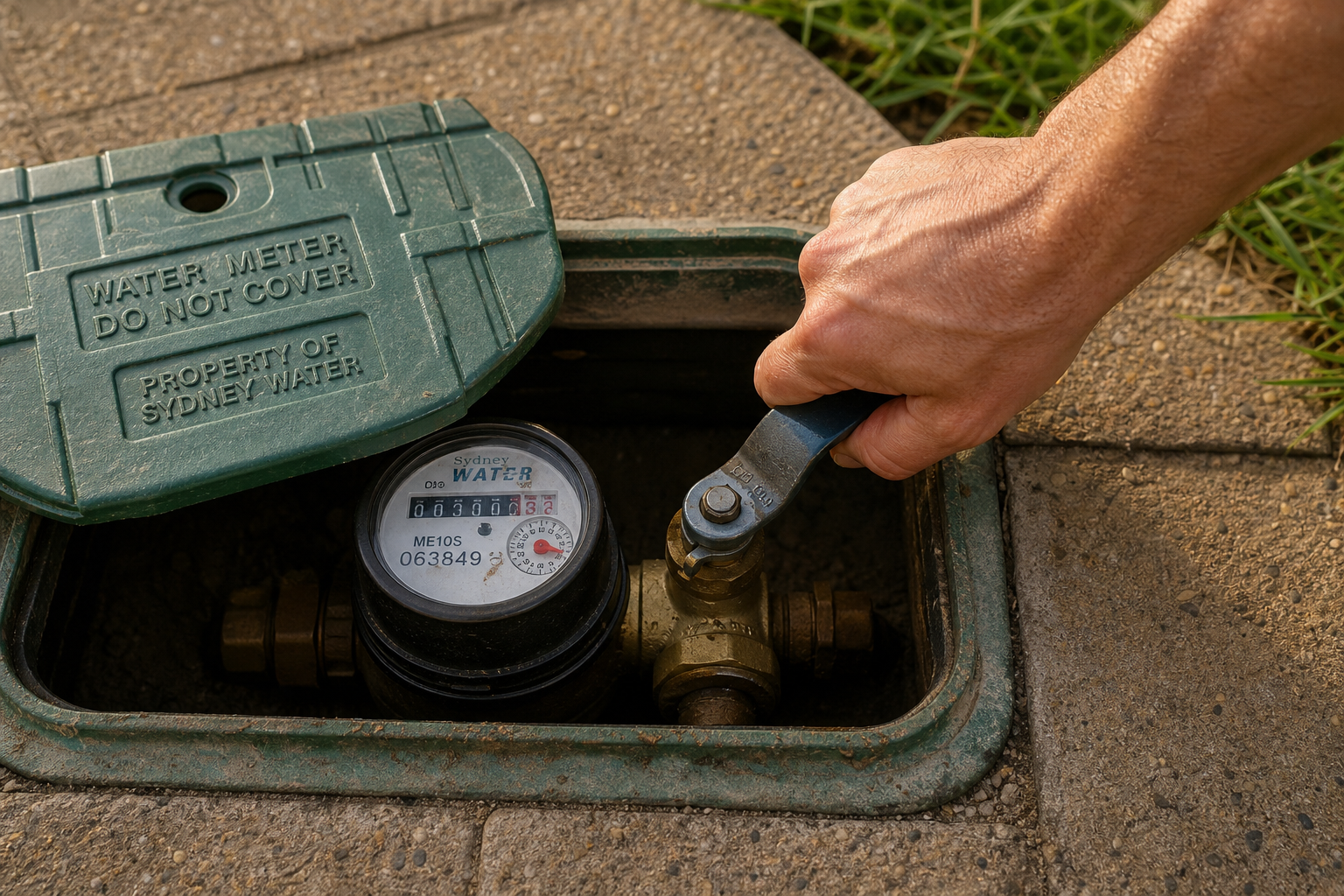
The single most useful piece of plumbing knowledge a Sydney homeowner can have is the location of their water mains shut-off valve and confirmation that it actually works.
We attend dozens of burst pipe call-outs a month where the homeowner has lost 200-500 litres of water through their floors in the time it took them to find their shut-off — sometimes because they couldn’t locate it, sometimes because they could locate it but couldn’t make it move. The damage from those few extra minutes typically runs into thousands.
This guide covers exactly where to find your shut-off, how to operate it, and what to do if it’s not where you expect. After shutting off, read our what to do when a pipe bursts guide, then call our burst pipe repair Sydney team.
Standard Sydney free-standing house
For around 80% of free-standing houses across the Sydney metropolitan area, the water shut-off valve is in the same place:
At the front property boundary, inside a small in-ground box, near the footpath.
The box is typically:
- Plastic (green, sometimes black) for newer builds
- Concrete for older builds
- Approximately 30cm × 20cm rectangular
- Set flush with the lawn or pavement
- Lid sometimes embossed “WATER METER” or with the Sydney Water logo
Lift the lid (a flathead screwdriver helps with stuck lids; gardening gloves help with dirt-encrusted ones). Inside you’ll see:
- The water meter itself — a brass or grey body with a dial-faced gauge showing cubic metres consumed
- A shut-off valve on each side of the meter
The valve on the house side (the side away from the road) is the one you operate. The valve on the road side belongs to Sydney Water and shouldn’t be touched.
The shut-off valve is one of two types:
- Lever type (most common in newer installs): a metal handle parallel to the pipe when open. Rotate 90° so it’s perpendicular to the pipe to close.
- Wheel type (older installs): a round wheel similar to a garden tap. Rotate clockwise to close — usually 8-10 full turns to fully shut.
Lever-type valves close instantly. Wheel-type valves take 30 seconds to fully close — give them time to seat properly.
Older Sydney terraces (Inner West, Eastern Suburbs, Surry Hills)
Pre-1920 terrace housing in the Sydney inner ring sometimes has the shut-off valve in non-standard locations:
- Behind the front fence panel (especially in heritage-listed Paddington and Surry Hills streets where boundary aesthetics matter)
- Inside a brass box recessed into the front step or path
- Adjacent to the building wall, sometimes inside a wooden door panel near the front door
If your terrace doesn’t have an obvious in-ground meter box, check those alternative locations. Strict heritage controls in some streets prevent the standard green-box installation.
Apartments and townhouses
Apartment plumbing is more complex because there are typically two relevant shut-offs:
Unit-level shut-off valve — controls water to your individual apartment. This is what you operate for in-unit emergencies (your flexi-hose has burst, your bathroom is flooding). Located:
- In the laundry (most common in newer builds)
- Behind a removable inspection panel in the laundry, bathroom, or kitchen
- Inside the hot water unit cupboard
- In the linen cupboard for some 1960s-80s walk-up blocks
The valve is typically a small lever, often partially obscured by laundry plumbing. Identify it on a non-emergency day.
Building-level riser shut-off — controls water to the entire column of apartments in your strata building. Located:
- In the building services cupboard (usually basement or ground floor)
- Sometimes in roof plant rooms for newer builds
- Accessible only by the building manager or strata-appointed trades
For unit-level emergencies you’d never operate the riser. If something major fails (a riser leak, common-property pipework failure), the building manager attends.
What about townhouses and villas?
Most Sydney townhouse complexes have:
- A community-level meter at the complex entry (Sydney Water bills the body corporate)
- A per-unit sub-meter at each individual townhouse boundary (body corporate bills units based on consumption)
Your unit-level shut-off is at the sub-meter, located the same way as a free-standing house — typically a green box near your front boundary.
How to test your shut-off valve
Knowing where the valve is doesn’t help if it doesn’t actually operate. Annual testing takes 5 minutes:
- Locate the valve
- Have someone inside watch a tap (any tap)
- Operate the valve to fully close
- Confirm the indoor tap stops flowing within 10-30 seconds
- Reopen the valve
- Confirm flow restored
If the valve won’t move, makes grinding noises, or the indoor tap keeps flowing after the valve is supposedly closed, the valve needs servicing. Either:
- Ring a plumber (replacement valve costs $180-280 including labour)
- Ring Sydney Water on 13 20 90 to attend the meter-side valve
Either way, fix it before there’s an emergency.
What to do if you can’t find your shut-off
Sydney Water requires every property’s water meter to be installed in an accessible location at the property boundary. If you’ve genuinely searched and can’t locate it:
- Check inside the front fence line. Some boxes are obscured by overgrown shrubbery or built-up dirt.
- Check beside the driveway entrance. Common alternative location for narrow-fronted properties.
- Check the strip between the fence and the footpath. Some councils require meters set in this verge area.
- Check inside the front gate/path area. Heritage properties sometimes have meters set in flagstone-style paths.
- Look for an inspection cover with the Sydney Water logo.
- Check your last Sydney Water bill — sometimes notes the meter location.
If you’ve genuinely looked and the meter is missing, buried, or inaccessible, ring Sydney Water on 13 20 90. They’ll attend to locate or expose the meter at no charge.
What to do during an actual emergency
If you’ve got an actual burst pipe right now and you can’t find the shut-off, the priority order is:
- Open every cold tap in the house at full flow. This relieves pressure trapped in the lines and slows the burst.
- Open the highest tap (top floor bathroom basin). Same reason, with maximum effect.
- Move soft furnishings away from the water spread.
- Photograph the scene for insurance documentation.
- Ring Sydney Water on 13 20 90 for emergency meter shut-off if you genuinely can’t locate yours.
- Ring an emergency plumber for the repair.
Sydney Water can shut off supply at the meter from their side in genuine emergencies — typical response is 30-60 minutes. Combined with opening upstream taps to relieve pressure, this contains the damage substantially.
Apartment-specific emergency response
For apartment dwellers, the emergency response sequence is slightly different because the riser shut-off is inaccessible:
- Operate the unit-level shut-off (laundry, behind inspection panel)
- If the leak continues, the failure is upstream of your unit valve — likely a common-property pipe
- Ring the building manager or strata after-hours line
- Ring an emergency plumber in parallel — they can attend while waiting for the riser shut-off to be accessed
- Photograph everything for both your contents claim and any strata claim
Don’t wait for the strata committee to convene. Emergency plumbers attend strata buildings routinely and liaise with building managers as part of standard process.
Going on holiday — the simple precaution
For trips longer than a week, the simplest insurance against returning to a flooded house is shutting off the water at the mains.
Procedure:
- Operate the shut-off valve to close
- Open one indoor tap (any tap) to release residual pressure
- Close the tap when the flow stops (within 30 seconds)
- The system is now depressurised and can’t burst
For trips of a few days, a lighter approach works:
- Turn off the supply taps to your washing machine (flexi-hose failures are the most common burst event in occupied homes)
- Turn off the supply tap to the dishwasher
- Confirm all internal taps are fully closed before you leave
These steps remove the most common burst risks without affecting the toilet flush capacity or anything else needed for an unattended period.
Final word
The five minutes you spend right now finding and testing your water shut-off valve is the single most useful plumbing investment a Sydney homeowner can make. The valve location should be:
- Known by everyone in the household
- Photographed and saved on the family group chat
- Tested annually to confirm it operates
- Marked on a printed page taped inside a kitchen cupboard for guests, house-sitters, or anyone unfamiliar with the property
Every emergency plumber Sydney has stories of customers losing thousands of dollars in damage during the few minutes it took to find a shut-off they’d never operated. Don’t be one of them. Save our 24 hour emergency plumber Sydney number now — before the emergency happens.