
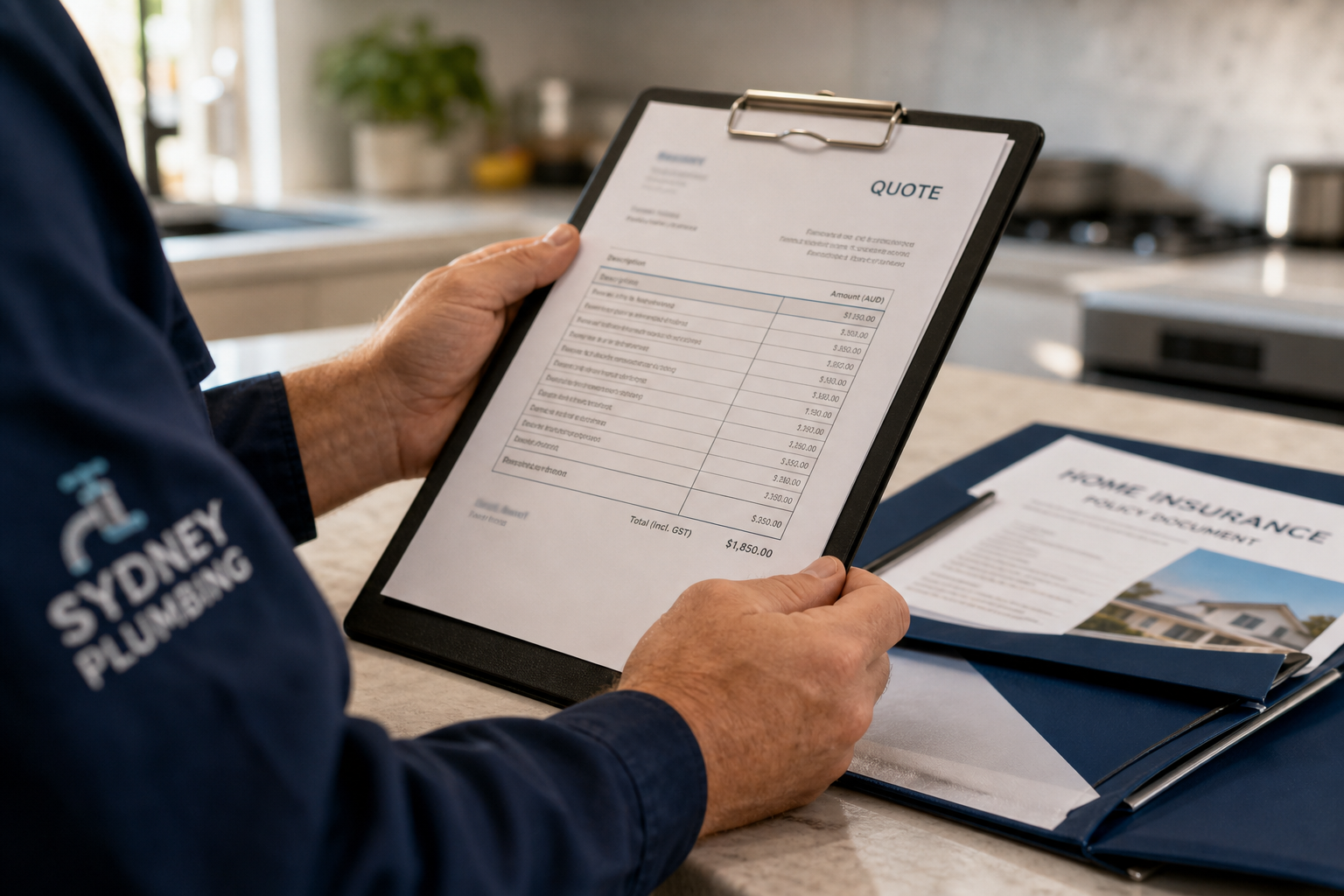
A burst flexi-hose under your kitchen sink can easily cause $15,000 to $40,000 worth of damage to flooring, cabinetry, plasterboard, and electronics across two or three rooms. Whether your home insurance pays for it depends on three things: what’s actually in your policy schedule, how the damage happened, and how the documentation is presented to the claims assessor.
This guide covers exactly what NSW home insurance does and doesn’t cover for burst pipe damage, the differences between the major insurers operating in Sydney, and the documentation that turns a borderline claim into an approved one. For the repair itself, see our burst pipe repair Sydney page — we supply insurer-ready documentation as standard.
The fundamental rule
Almost every standard NSW home and contents policy includes the following two principles:
- Sudden, unexpected damage is covered. Carpets, furniture, plasterboard, cabinetry, electronics, white goods damaged by water that arrived without warning.
- The cause of the damage is not covered. The pipe itself, the failed flexi-hose, the corroded joint — these are maintenance items. The insurer pays for the consequences, not the cure.
That’s the foundation. Almost every claim outcome traces back to how those two principles get applied to your specific situation.
What’s typically covered
Standard NSW home and contents policies (NRMA, AAMI, Allianz, Suncorp, CommInsure, RAA, Budget Direct, Youi) generally cover:
- Damaged carpets, underlay, flooring (timber, vinyl, tiles)
- Saturated plasterboard and ceiling sheeting
- Wet timber framing requiring replacement
- Damaged cabinetry (kitchen, bathroom, built-in wardrobes)
- Personal contents — clothing, electronics, books, furniture
- Damaged appliances if water-damaged (dishwasher, washing machine, fridge motors)
- Drying and dehumidification services
- Mould remediation if directly attributable to the burst event
- Emergency accommodation if the home becomes uninhabitable
- Structural repairs to walls, ceilings, floors
- Re-painting and re-finishing of damaged areas
What’s typically excluded
The same policies generally exclude:
- The cost of repairing or replacing the failed pipe, fitting, hose, or component itself
- Damage from leaks the policyholder knew about and didn’t address (the “you should have called sooner” exclusion)
- Damage from gradual leakage (slow weeping over weeks or months)
- Damage from poor workmanship by previous plumbing repairs
- Damage from natural wear and tear of pipework over time
- Damage where the claim documentation is insufficient
- Damage to swimming pools and spa equipment (separate cover often required)
- Damage caused during DIY plumbing attempts
The “sudden vs gradual” distinction
This is where most claim disputes happen.
Sudden damage example: A 15-year-old flexi-hose under the kitchen sink fails catastrophically overnight while you’re asleep. You wake to a flooded kitchen, isolate the supply, ring a plumber. The plumber documents “sudden mechanical failure of the supply line, no prior visible defect.” Claim straightforward.
Gradual damage example: A copper joint behind the bathroom basin develops a hairline weep. Over six weeks, water gradually saturates the wall cavity, rotting the timber framing and spreading mould. By the time you notice the warped skirting board and ring a plumber, the damage is significant. The plumber documents “progressive corrosion of joint with extensive secondary damage.” Claim probably refused as a maintenance issue.
The honest reality is that most pipe failures sit somewhere on a spectrum between those two cases. The plumber’s documentation language matters enormously to where on the spectrum the assessor places the claim.
We word every report to accurately reflect what we observed, without inflating or downplaying. “Mechanical failure of fitting, no prior visible defect noted by occupants” is honest in the vast majority of burst hose cases — that exact wording gets claims approved.
Insurer-by-insurer notes
Coverage details vary slightly between major NSW insurers. Based on claims we’ve supported documentation for:
NRMA / Insurance Australia Group: Generally responsive, requires plumber’s licence number and invoice to be itemised by labour and parts separately. Time-stamped photos required. Will sometimes request a follow-up inspection by their assessor — this is normal and not a sign of imminent rejection.
AAMI: Documentation requirements similar to NRMA, plus written description on plumber’s letterhead (not just an invoice line). Slightly faster turnaround on claims under $10,000. Responsive to plumber-supplied additional reports if initial claim queried.
Allianz Australia: Detailed documentation requirements including “likely cause” classification (sudden vs gradual). Tends to push back on borderline cases — additional plumber’s report often required for claims over $5,000. Very fast on clear-cut cases.
Suncorp: Generally pragmatic on burst pipe claims. Itemised invoice and photos usually sufficient. Larger claims (over $15,000) require their assessor visit before approval.
CommInsure (CBA-aligned): Stricter on documentation than most. Insists on the plumber’s licence number being verifiable on the NSW Fair Trading register. Some recent claims have required electrical certification confirming no underlying electrical damage caused the failure.
Budget Direct, Youi, Coles Insurance: Generally light-touch documentation requirements for small claims (under $5,000); more forensic for larger claims. Photos and itemised invoice usually sufficient.
For all insurers, the strongest single predictor of a fast, hassle-free claim outcome is photos of the failure point before any repair work is done, taken alongside photos of the damage to contents and structure. Insurers can argue about the amount of contents damage; they can’t argue about the existence of the burst pipe if you’ve photographed it.
Documentation checklist for a successful claim
If you’re ringing your insurer about burst pipe damage, the strongest claim file includes:
- Photos of the failure point — flexi-hose, pipe, fitting, whatever — before any repair work
- Photos of the water spread — full rooms, wet floors, damaged ceilings
- Photos of damaged contents — in original positions if possible, before anything is moved
- Time-stamped phone photos are accepted by all major insurers
- Itemised plumber invoice with NSW Fair Trading licence number visible
- Written description on plumber’s letterhead of likely cause and failure mode
- Inventory of damaged contents with approximate purchase dates and replacement costs
- Receipts for anything you’ve already replaced (drying equipment hire, replacement bedding etc.)
- Quotes for restoration work (carpet replacement, plasterboard repair, painting)
We supply items 1, 5, and 6 as standard with every emergency plumbing call. Items 7-9 are your responsibility but the strongest claims have all of them assembled before lodging.
What we provide that strengthens claims
Every burst pipe call-out we attend includes documentation specifically formatted to meet NSW major-insurer requirements:
- Photos taken on arrival — failure point, water spread, affected rooms — emailed to you the same day
- Photos taken during the repair — exposed pipework, replaced components, completed repair — emailed to you with the invoice
- Itemised invoice showing labour, parts, and total separately; NSW Fair Trading licence number prominently displayed
- Likely cause statement on letterhead — usually 2-3 sentences describing what we observed and what most likely caused the failure, in plain language insurers expect
- Failed component retained if the insurer wants to inspect it (we can hold for up to 30 days)
- Follow-up reports if the insurer requests additional documentation — supplied at no charge
This isn’t unusual or special — it’s what every reputable Sydney emergency plumber should be supplying as standard. If your plumber doesn’t, ring us for the documentation even after the repair is complete; we can attend a documentation-only inspection at modest cost.
What to do if your claim is initially rejected
Insurance assessors aren’t always right. Initial rejections can often be successfully challenged with the right additional information.
Step 1: Request the rejection in writing, with specific reasoning. The insurer is legally required to provide this on request.
Step 2: Read the reasoning carefully. Most rejections fall into a small number of categories:
- “Maintenance issue” (gradual damage classification)
- “Insufficient documentation”
- “Not covered under your policy”
- “Pre-existing damage”
Step 3: Get a follow-up plumber’s report specifically addressing the rejection reasoning. We routinely write second reports for customers whose initial claim was queried — usually takes us 30 minutes and costs $150-250.
Step 4: Resubmit the claim with the additional documentation, referencing the rejection letter directly.
Step 5: If still rejected and you genuinely believe the rejection is wrong, escalate to the Australian Financial Complaints Authority (AFCA). Free, independent dispute resolution. Insurers take AFCA escalations seriously and many disputed claims are resolved at this stage.
Final word
NSW home insurance covers a lot more burst pipe damage than most homeowners assume — particularly contents and structural damage. The pipe itself isn’t covered, but the consequences usually are when documentation is properly assembled.
The single most useful thing you can do is photograph the failure point before any repair work begins. That one set of photos resolves more disputed claims than any amount of back-and-forth correspondence afterwards.
Pick a plumber who supplies insurance-grade documentation as standard. Read your policy schedule before you need to. Lodge within 7 days of the event. The system works fine when those basics are in place.
Our emergency plumber Sydney service includes dated itemised invoices, licence numbers, photos, and written cause-of-failure reports — everything your insurer will ask for. See our response time guide if you need to know when we can get to your suburb.