
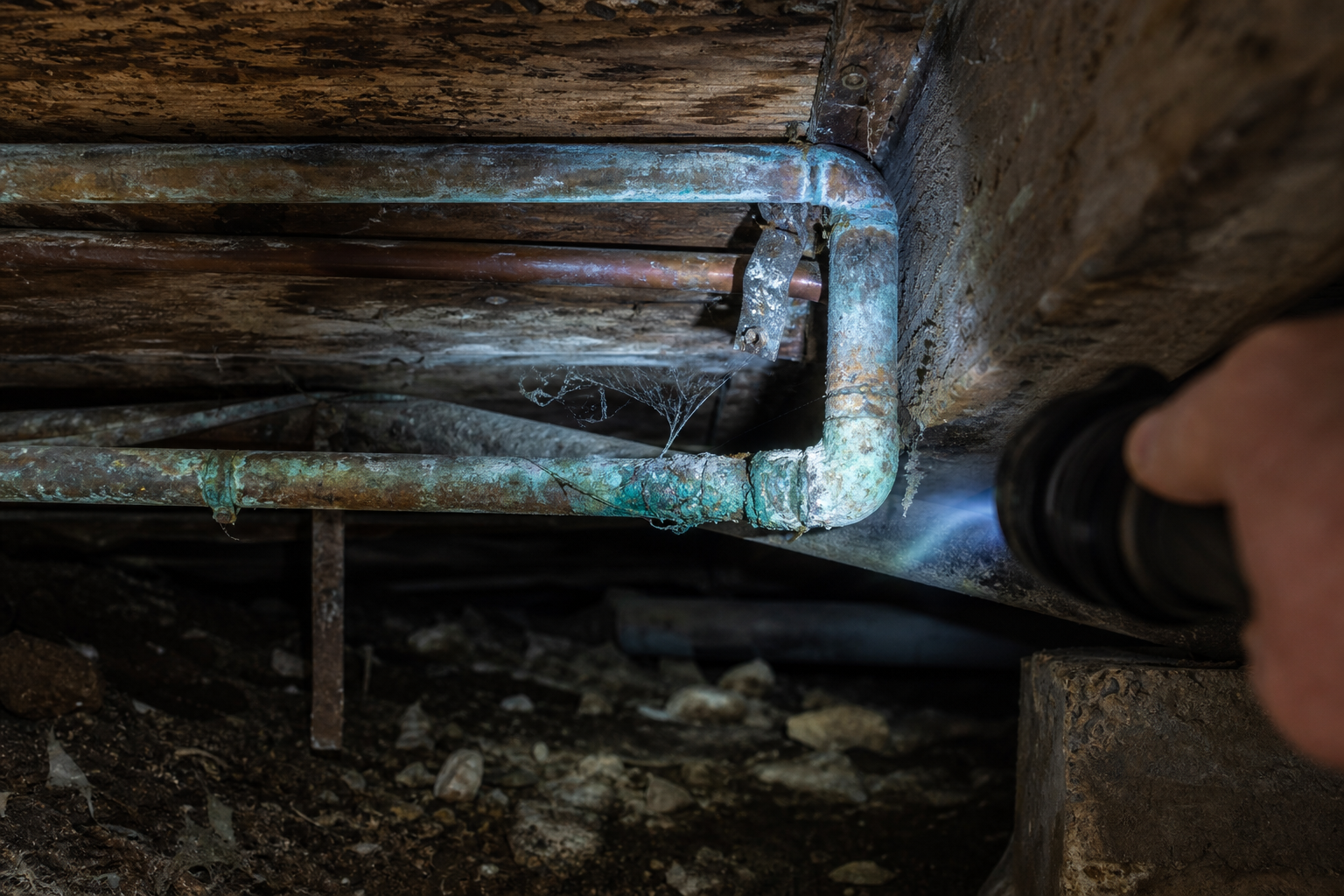
Sydney’s housing stock spans 200 years of evolving plumbing practice. A Paddington terrace built in 1885, a Federation cottage in Glebe from 1905, an art deco apartment block in Bondi from 1934, and a post-war brick veneer in Concord from 1955 each have different pipework, different failure patterns, and different remediation requirements.
This guide covers the plumbing characteristics of Sydney’s main heritage housing eras, the specific problems each typically develops, and what reasonable remediation looks like. Old pipe failures often hit suddenly — our burst pipe repair Sydney team specialises in heritage-property emergencies where access is awkward and materials are obsolete.
Victorian (1840-1901)
The original colonial period. Sydney suburbs built in this era include parts of Surry Hills, Paddington, Woollahra, Redfern, Newtown, Glebe, Balmain, and the Rocks.
Plumbing characteristics
- Service line from boundary to building: Often original lead pipework still in some pre-1900 properties. Replaced during routine works in most cases over the past century.
- Internal supply lines: Galvanised iron with brass fittings. Copper appearing in higher-end builds from the 1890s onward.
- Sewer lines: Original glazed clay (or “salt-glazed earthenware”) with mortar-bonded joints. Internal diameter typically 100mm.
- Toilets: Original outhouse arrangements progressively replaced with internal water closets through the 1890s-1910s.
- Hot water: Originally none — fuel-fired bath boilers in the kitchen. Gas wall heaters appeared in the 1890s-1910s. Electric storage from the 1930s onwards.
Common problems we see today
Pinholes in galvanised supply lines. After 100+ years, internal corrosion has reduced wall thickness throughout. Pinhole leaks appear at joints, elbows, and behind fixtures. Repair is section replacement; whole-house re-pipe in PEX is the eventual endpoint.
Lead service line exposure. Some pre-1900 properties retain original lead from the boundary to the meter. Not currently a NSW Health priority but progressively replaced as other works require.
Mortar-bonded clay sewer joint failure. The lime mortar between sewer pipe sections has typically dissolved over the century, leaving open joints that admit roots. Standard remediation: hydro-jet, root cut, then sewer reline.
Cracked vitrified clay pipework from ground movement. Older sewer lines in clay soils crack at the joints from both root intrusion and decades of soil movement. Relining is the standard modern fix.
Grease accumulation in undersized waste pipes. Original 50mm kitchen waste lines clog with modern dishwasher and disposal loads. Upsize to 65mm or 80mm during renovation.
Reasonable maintenance approach
For heritage Victorian properties:
- CCTV inspection of sewer line every 5 years
- Section re-pipe of supply lines as failures occur (rather than preventive whole-house replacement)
- Sewer relining when root intrusion repeatedly recurs
- Heritage-compatible fixture choices (Caroma reproduction suite for replacements)
Federation (1890-1915)
Sydney’s classic Federation cottages — bullnose verandahs, leadlight windows, generous ceilings. Built across the inner and middle rings: Hurlstone Park, Marrickville, Petersham, Croydon, Strathfield, Lane Cove, Mosman, Lindfield, parts of Bondi.
Plumbing characteristics
- Service line: Galvanised iron, sometimes original lead at the very oldest examples. Predominantly replaced over time.
- Internal supply: Galvanised iron throughout. Copper becoming standard in higher-end builds.
- Sewer lines: Glazed clay with mortar joints; some later examples used cement mortar with better longevity.
- Toilets: Internal water closets standard. High-cistern pull-chain designs in original installs.
- Hot water: Coal-fired chip heaters in many original installs; progressively replaced through the 20th century with gas and electric units.
Common problems we see today
Galvanised pipe failure clustering. Federation-era galvanised lines installed simultaneously fail in clusters — once one section pinholes, the surrounding sections are usually within months of similar failures. Section replacement is reactive; many homeowners eventually opt for full re-pipe to escape the recurring emergencies.
Original cast iron stack failures. The vertical waste stack serving upper-floor bathrooms in two-storey Federation houses was typically cast iron. After 100+ years, internal corrosion reduces capacity and external rust eventually causes wall failures. Replacement with PVC stack is the modern standard.
Leaking toilet pan-to-floor seals. Original WC pans bedded on putty seals fail as the putty hardens and cracks. Symptoms: slight ammonia smell in the toilet area, occasional dampness under the pan. Replacement seal is straightforward; full pan replacement often makes sense given age.
Inadequate venting causing slow drains. Original sewer ventilation often consisted of a single roof vent that’s now partially blocked by leaf litter, bird nests, or possum activity. Adequate venting restores flow.
Hot water unit cladding rust on Federation sun-room installations. Many Federation houses have hot water units in external sun-room or back-veranda positions where rain hits the unit cladding. Premature failure of the unit shell is common. Position relocation during replacement (interior cupboard or covered position) is recommended.
Reasonable maintenance approach
- Section re-pipe in PEX as galvanised failures occur
- Plan for stack replacement during any major bathroom renovation
- Adequate vent maintenance (clear annually)
- Modern hot water unit positioning during replacement
Art Deco (1925-1945)
The classic Sydney inter-war period. Apartment blocks across Bondi, Coogee, Potts Point, Elizabeth Bay, Cremorne, Manly. Brick cottages across Burwood, Concord, Five Dock, Drummoyne, Mascot, Maroubra.
Plumbing characteristics
- Service line: Galvanised iron standard. Copper increasingly common in higher-end art deco apartment installs.
- Internal supply: Mix of galvanised and copper, often with copper for hot water lines and galvanised for cold. Brass fittings throughout.
- Sewer lines: Glazed clay with cement mortar joints. Cast iron stacks in apartment buildings.
- Hot water: Gas storage units becoming common. Some early electric storage installs.
Common problems we see today
Mixed-material galvanic corrosion. The combination of galvanised cold supply with copper hot water creates galvanic corrosion at every joint between dissimilar metals. Failures appear at brass fittings where the two materials meet. Standardising material during section repairs (everything to PEX, or everything to copper) eliminates the issue.
Cast iron stack failures in art deco apartment buildings. Apartment blocks built in the 1925-1945 era have cast iron vertical waste stacks now reaching end of life. Failures are typically common-property (strata) responsibility but cause cosmetic and water damage to individual units. Strata committees should plan for stack replacement programs.
External tap freeze-and-thaw damage. Art deco apartment balconies sometimes have external taps with no isolation valve. While Sydney rarely freezes, sustained cold snaps in 1955, 1986, and 2002 caused widespread external tap failures across these buildings. Modern installs include isolation valves to allow draining.
Salt-air corrosion in beach-zone apartments. Art deco apartments in Bondi, Coogee, Manly, Cronulla suffer accelerated external fitting corrosion from salt-air exposure. Marine-grade brass fittings during replacement extend service life significantly.
Original Caroma cistern internals failure. Caroma cistern mechanisms from the era are still functioning in many properties but reaching end of life. Replacement of internals with modern Caroma kit is straightforward — preserves the heritage look of the cistern external while restoring modern function.
Reasonable maintenance approach
For art deco apartments:
- CCTV inspection of common waste stacks (strata responsibility)
- Marine-grade fittings during any external pipework replacement
- Standardise hot/cold material during repairs (PEX for both)
- Modern Caroma internals while preserving original cistern shells
Post-War (1945-1965)
The “California bungalow” and early brick veneer era. Suburbs across Pagewood, Maroubra, Concord, Strathfield South, Auburn, Sydenham, Campsie, Lakemba, Bankstown.
Plumbing characteristics
- Service line: Copper standard from boundary to building.
- Internal supply: Predominantly copper with brass fittings. Some galvanised remaining in cheaper builds.
- Sewer lines: Glazed clay with cement mortar through 1955; PVC progressively replacing clay from late 1950s.
- Hot water: Electric storage standard, gas storage as a secondary option. Rinnai gas instantaneous units appearing from late 1950s.
Common problems we see today
Copper supply line ageing. Original 1945-1965 copper supply lines are now 60-80 years old — within the failure window for the era’s solder and material quality. Failures cluster at joints. Section repair or whole-house re-pipe in PEX as failures indicate.
Hot water unit replacements approaching their second cycle. Original electric storage units installed in the 1950s have typically been replaced two or three times. Many post-war homes are now on their fourth-generation hot water unit. Cycle is 12-15 years for most installs.
Modern flexi-hose failures replacing original copper risers. When sinks, basins, and toilets are renovated, original copper risers are often replaced with rubber-jacketed flexi-hoses that fail catastrophically after 8-12 years. Mass replacement of flexi-hoses every decade is the appropriate maintenance schedule.
Inadequate kitchen waste sizing for modern appliances. Original 50mm kitchen waste lines undersized for modern dishwashers, garbage disposers, and high-volume cooking. Upsize to 65mm during kitchen renovation.
Reasonable maintenance approach
- Plan whole-house copper re-pipe in PEX as joint failures begin to recur
- Replace flexi-hoses every 8-10 years preventatively
- Upgrade waste line sizes during renovations
- Modern hot water unit selection (heat pump preferred for energy efficiency)
1965-1985 (the polybutylene era)
A specific concern. Homes built or re-piped between approximately 1975 and 1995 may have polybutylene (PB) supply lines that are now reaching catastrophic failure age.
PB pipes are easily identified — usually grey or sometimes blue, flexible plastic, with metal compression fittings at every junction. The material degrades from chlorine exposure over decades, becoming brittle and prone to sudden failure (often without leak warning).
If you’ve discovered PB in your Sydney home, treat it as a known-failure-risk item. Section replacement when failures occur, or preventive whole-house re-pipe in PEX. Insurance coverage of PB-related damage is sometimes contested by insurers as “known defective material” — get plumber documentation in writing.
Final word
Heritage Sydney homes have characterful plumbing — and characterful plumbing failures. The patterns are predictable by era. If you own one of these properties:
- Get a baseline plumbing inspection by a heritage-experienced Sydney plumber
- Plan for the typical end-of-life of your era’s pipework
- Address failures promptly — they tend to cluster
- Consider whole-house re-pipe when section repairs become recurring
The economic comparison usually favours preventative whole-house work over the ongoing emergency call-out costs once a heritage property’s pipework starts failing in earnest. We typically recommend conversion to PEX run through wall cavities and ceiling spaces — preserves heritage finishes while modernising the infrastructure.
See our pricing guide for re-pipe and emergency repair cost estimates, or check your suburb in our Sydney service area coverage.