
A fully blocked sewer line in a Sydney home is genuinely awful — raw sewage backing up into the laundry tub, slow gurgling toilets, that distinctive smell that lingers in soft furnishings for weeks afterwards. The repair bill, including any structural and remediation work, can run into five figures.
The good news: a blocked sewer line almost never appears suddenly. It develops over weeks or months, sending steadily escalating warning signs. Catch any of the nine signs below early enough and the fix is a $200 mechanical clearance instead of a $4,000 remediation project.
This is the diagnostic checklist our plumbers walk through on every CCTV inspection. Here it is in plain language for Sydney homeowners. If you’re already past the warning signs, our blocked drain emergency Sydney team clears most lines same-visit.
Sign 1 — Gurgling sounds from drains
The earliest warning sign in almost every blocked sewer case. You’ll notice it most clearly when:
- The toilet flushes and the bathroom basin gurgles a few seconds later
- The washing machine drains and the laundry trough makes a glug-glug sound
- The kitchen sink empties and you hear water moving in the bathroom
The mechanism: a partial blockage downstream creates pressure imbalances in the line. As water flows past the partial obstruction, air gets drawn through fixture traps, producing the characteristic gurgle. It’s the line telling you that flow capacity is reduced.
This sign appears weeks before any visible symptoms. Most Sydney homeowners ignore it.
Sign 2 — Slow draining across multiple fixtures
A single slow drain (just the bathroom basin) usually means a local hair plug or trap blockage. Slow draining across multiple fixtures simultaneously indicates the blockage is downstream of all of them — almost always in the main sewer line.
Pay particular attention if:
- The kitchen sink, bathroom basin, and shower all drain slower than they used to
- The laundry tub is taking longer to empty after a wash cycle
- The toilet flushes weakly and water sits at a higher-than-normal level afterward
Multi-fixture slow draining is the line warning you that a significant downstream restriction exists. Time to ring a plumber.
Sign 3 — Sewer smell inside the house
Sewer gas (a mix of methane, hydrogen sulphide and other hydrocarbons) escapes when:
- A trap dries out (rare in regularly-used fixtures)
- A vent pipe is blocked or damaged
- The line is partially blocked and gases are escaping past fixture traps
The smell is unmistakable — sulphurous, organic, persistent. Different from the typical drain smell that develops in seldom-used fixtures. If you can smell it consistently in the laundry, kitchen, or bathroom, particularly after fixture use, the sewer line needs investigating.
Sign 4 — Water backing up where it shouldn’t
This is the one most homeowners eventually notice. Symptoms include:
- Water rising in the shower base when the washing machine drains
- The laundry trough filling up when the toilet flushes
- The toilet bowl rising when the kitchen sink empties
- Water appearing through the floor waste in the laundry
By the time water is appearing where it shouldn’t, the blockage is substantial. You’ve moved from “early warning” to “active emergency.” Stop using all fixtures and ring a plumber immediately.
Sign 5 — Patches of unusually green or lush grass over the sewer line
This one’s specific to homes with their main sewer line running through the front or back yard rather than under the slab.
If you’ve got a strip of grass that’s noticeably greener, longer, or more lush than the surrounding lawn, particularly in a straight line from the house to the boundary, that’s almost certainly a slow leak from the sewer line below. Tree roots have likely breached the pipe; sewage is leaking into the soil and feeding the grass above.
In severe cases, you may also notice:
- Soft or boggy patches that don’t dry out between rain events
- A faint sewage smell when walking across the area
- Sinkhole-like depressions where soil has eroded around the leak
Common in older suburbs (Newtown, Glebe, Marrickville, Leichhardt, Paddington, Surry Hills, Lane Cove) where original clay sewer lines run through clay soils and mature trees.
Sign 6 — Mould or moisture marks on walls and ceilings near plumbing
Slow sewer leaks behind walls or under floors don’t always present as visible water — sometimes the first sign is mould developing on the inside surface of a wall adjacent to the leak.
Look for:
- Black or green mould on plasterboard near bathrooms, toilets, or the laundry
- Wallpaper bubbling or peeling near plumbed walls
- Stained patches on ceilings below upstairs bathrooms
- Warped or cupped flooring near plumbed fixtures
The mould isn’t the problem — it’s the symptom of an underlying moisture source that needs investigation.
Sign 7 — Toilets flushing weakly or incompletely
Healthy toilet flushing depends on adequate downstream flow capacity. When the sewer line is partially blocked, water can’t move away from the bowl quickly enough, producing:
- Weak flushes that don’t fully clear the bowl
- Toilets that need to be flushed twice or three times
- Water rising higher in the bowl during the flush before receding
- Bubbles or gurgling in the bowl after flushing
- The bowl water level dropping noticeably after flushing (siphon effect from downstream pressure imbalance)
If you’ve got two or more toilets in the house and both are showing the same symptoms simultaneously, the blockage is definitively in the main line, not the individual toilet.
Sign 8 — Frequent fixture-level blockages across the house
If you find yourself plunging different drains every few weeks — this week the shower, last week the kitchen sink, the week before the laundry — it’s not bad luck. It’s a downstream sewer line running at reduced capacity, causing each fixture to back up in turn as small amounts of additional waste push past the partial obstruction.
Track the pattern. Multiple unrelated fixture blockages within a month is a strong indicator of an upstream issue.
Sign 9 — Sewer flies or drain flies appearing inside
Small (2-3mm) dark flies congregating around drains, particularly in the bathroom or laundry, indicate organic matter accumulating in or near the drain — usually because flow is restricted and material is settling rather than flushing through.
Sometimes called “moth flies” or “drain flies,” they breed in the slime that forms inside slow-draining or partially-blocked lines. They don’t transmit disease but their presence indicates something needs attention downstream.
What to do if you’ve spotted any of these signs
A few practical steps:
Don’t try to fix it yourself with chemicals. Caustic drain cleaners damage older Sydney pipework, void manufacturer warranties on PEX, don’t break down root masses, and create splash-back hazards.
Stop using the affected fixtures. Adding water to a partially blocked line accelerates the backup. Use other fixtures sparingly until the line is investigated.
Note the symptom pattern. Which fixtures are affected? When did each symptom start? This information lets the plumber localise the blockage faster.
Ring a plumber for a CCTV inspection. A camera inspection is the only definitive diagnostic — it shows exactly where the blockage is, what’s causing it, and whether mechanical clearance or a more substantial repair is needed.
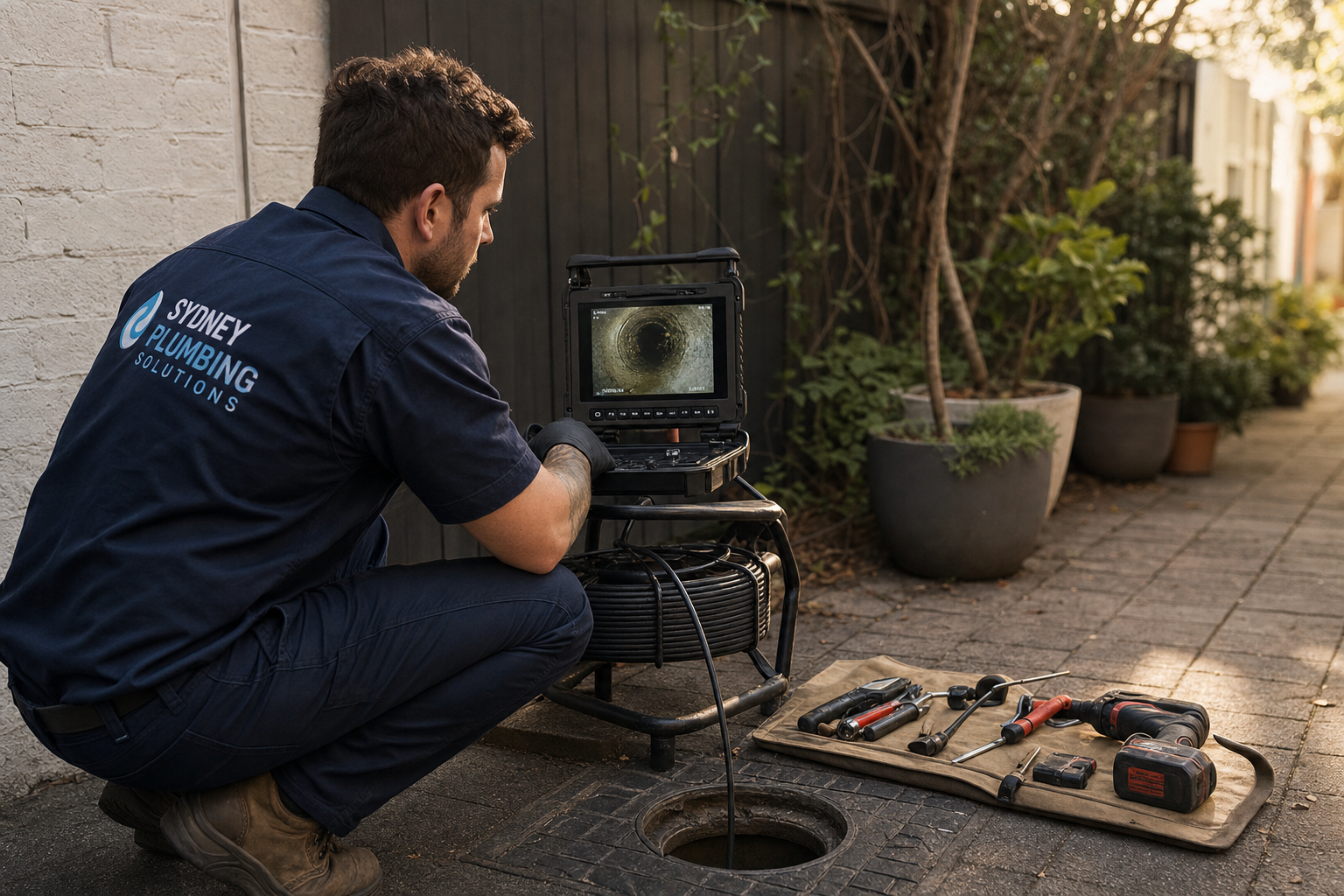
What a CCTV inspection actually involves
A standard sewer CCTV inspection takes 45-90 minutes:
- Plumber locates the inspection point — typically a clearance point in the front or rear yard, or a roof vent
- Camera inserted on a flexible push rod, fed downstream through the line
- Live video review on a monitor — the plumber walks through what’s visible, you watch alongside
- Recording captured for your records and any insurance documentation
- Written report with location of any defects (in metres from the inspection point), recommended remediation, and rough pricing
Cost: $220-350 standalone; usually included free if combined with a clearance call-out.
Sydney-specific patterns we see
A few patterns that recur across the Sydney metro:
Inner West and Eastern Suburbs (pre-1960 housing): Original clay sewer lines with unsealed joints. Tree root intrusion at joints is the leading cause of blockages in these areas. Common trees responsible: jacaranda, fig (Moreton Bay and Port Jackson varieties), eucalyptus, paperbark, willow, and most fruit trees within 20 metres.
Western Sydney slab-on-ground homes: Newer builds (post-1990) typically have PVC sewer lines with sealed joints — fewer root intrusions, but more grease and wet-wipe accumulations. Younger households with multiple bathrooms and dishwashers stress the line capacity.
Apartment buildings (CBD, Surry Hills, Bondi, Pyrmont, Chatswood, Parramatta): Common-property sewer risers carry waste from multiple units. Blockages frequently originate upstream of your unit (someone else’s wet wipes); the cost allocation is a strata matter rather than a unit-owner cost.
Hills District and Northern Beaches septic systems: Some areas of the Hills (Glenhaven, Galston, Dural) and Northern Beaches (Avalon Beach, Whale Beach) still operate on septic systems rather than mains sewer. Different diagnostic patterns, different remediation. Worth knowing what your property is on before you ring a plumber.
Final word
Blocked sewer lines almost never appear suddenly. The nine signs above show up in the weeks and months before the catastrophic backup that drives the emergency call. The cheaper response is always the earlier response.
If you’ve noticed two or more of these signs in your Sydney home, book a CCTV inspection. Cost is modest, the information is permanent (recording stays on file), and the early intervention saves significant money compared to remediating sewage damage later. Our blocked drain emergency Sydney service includes same-visit CCTV on request — see pricing for what to expect.