
Sydney’s wet season runs October to March, with the heaviest rain events typically clustering January through March. In a normal La Niña year, the metro will see 4-7 major East Coast Low events, each capable of dumping 100-200mm of rain in 24-48 hours. Track incoming weather at the Bureau of Meteorology Sydney forecast.
The plumbing problems caused by those events are largely predictable and largely preventable. Most of what we attend during storm season traces back to maintenance items that should have been done in September.
This is the checklist we recommend Sydney homeowners run every year, ideally before mid-October. When a storm does create an emergency, our emergency plumber Sydney responds across all Sydney regions — check your suburb.
Why Sydney’s storm plumbing is a specific problem
Three factors combine to make Sydney’s wet season particularly hard on residential plumbing:
Combined sewer/stormwater systems in older suburbs. Pre-1960 inner-ring suburbs (Surry Hills, Newtown, Glebe, Paddington, Chippendale) often have combined systems that take both household waste and rainfall runoff into the same pipe. Heavy rain overwhelms the capacity, causing surface water to back up through floor wastes and gully traps.
Eucalyptus leaf litter. Sydney’s most common street trees (spotted gum, red gum, lemon-scented gum) drop heavy leaf litter year-round. Gutters fill rapidly, downpipes block, surface drains clog. The single biggest preventable cause of stormwater damage.
Old-stock galvanised iron pipework. Heritage housing across the inner suburbs often runs on galvanised supply lines that corrode internally over decades. Pressure spikes during storm events (water hammer from rapid draining and pump cycling) can trigger failures in already-weakened sections.
October checklist — 60 minutes
Done in late September or early October, this list prevents most storm-season call-outs.
1. Clear all gutters of leaf litter and debris
Particularly important under eucalyptus, paperbark, jacaranda, and brushbox trees. Remove leaves, seed pods, twigs, and accumulated silt. Ladder access only — don’t attempt from a roof. Hire a professional for two-storey homes or homes with steep pitched roofs ($150-280 typical cost).
2. Confirm downpipe clearance
After clearing gutters, run a hose down each downpipe. Water should flow freely to the surface drain at ground level. Blockages are typically caused by accumulated debris at the elbow joint or at ground level entering the drain. Mechanical clearance from the top usually resolves it.
3. Clear surface drains and sumps
Walk the perimeter of the house, identifying every grate-covered surface drain. Lift each grate, remove accumulated leaves and silt. Pour a bucket of water down each to confirm clearance.
4. Test the operation of any sump pumps
Homes in flood-prone areas (parts of Penrith, Liverpool, lower North Shore valleys) often have sump pumps in basements or under-house spaces. Test by pouring 20 litres of water into the sump — pump should activate automatically and clear within 60 seconds.
5. Inspect the hot water unit cladding (outdoor units)
External hot water units (gas instantaneous, electric storage) should have intact cladding with no rust holes, no cracked or missing seals, and no obvious water ingress points. Particular attention to the top of the unit (often the first failure point) and the area around external pipework entry/exit.
6. Check the seal around outdoor power outlets near hot water units
Outdoor power outlets serving hot water units, pumps, or pool equipment should have intact silicone seals around the back-box. Water ingress through cracked seals is a common cause of post-storm electrical faults.
7. Test the operation of the water mains shut-off valve
Walk to the meter, lift the box lid, operate the shut-off valve to fully close, then reopen. Confirm it moves freely. Annual testing keeps the valve operable for genuine emergencies.
8. Verify septic tank or aerated wastewater system status
Properties on septic systems (parts of the Hills, Northern Beaches edge, outer south-west) should have current pump-out records. Heavy rain can flood undersized soakaways causing backup into the house.
9. Test sump and basement drains
Floor wastes in laundries, basements, and garages should drain freely. Pour 20 litres of water and confirm it clears within 60 seconds. Slow-draining floor wastes during storm season indicate either reduced capacity in the line or debris accumulated at the trap.
10. Photograph the property exterior
Take photos of all visible plumbing, gutters, downpipes, surface drains, hot water units, external taps. Saves significant documentation time if a storm-related claim is needed later.
During-storm response
When a major storm event is forecast (BOM severe weather warning, typically 6-12 hours notice):
Move outdoor furniture, garden tools, and storage clear of downpipe outlets and surface drains. Items pushed against drainage create blockages exactly when capacity is needed most.
Bring in vehicles parked on grass. Saturated lawns become unstable; vehicles sink in and damage underground pipework.
Move soft furnishings clear of any walls below downpipe outlets or near windows facing prevailing wind direction. Gust-driven rain enters around window frames in many older Sydney homes.
Have emergency contact numbers visible — your insurer’s after-hours claims line, an emergency plumber, the SES (132 500), Sydney Water emergencies (13 20 90).
Don’t shower, run washing machines, or use dishwashers during peak rainfall if your property is on a combined sewer/stormwater system or in a known backup-prone area. Adding to the system load during overflow conditions makes backup more likely.
Post-storm checklist
In the 24-72 hours after a major event:
Walk the property. Look for new water marks on internal walls near the ceiling line (indicating roof or eave water entry), soft or boggy patches in the lawn (indicating subsurface leaks or sewer issues), water marks on external walls (indicating overflowing gutters), and any new leaks at fixtures.
Test the hot water. Outdoor units sometimes fail 24-72 hours after a storm event due to slow water ingress to electronics. Hot water failure during this window is almost always storm-related.
Check for rising damp on internal walls. Wet weather often exacerbates pre-existing rising damp in older Sydney homes; new or worsening damp marks indicate that maintenance attention is overdue.
Review insurance documentation if anything has gone wrong. Photos of damage, plumber invoices, time-stamped notes. Most NSW insurers require lodgement within 30 days.
Storm-related issues we see most often
Based on call-out volumes during recent wet seasons:
Overflowing gutters causing internal water marks — by far the most common storm-related call. Water cascades from the gutter edge, runs down the wall, enters via the eave-to-wall junction. Damage is to internal plasterboard near the ceiling line.
Blocked downpipes flooding garden beds against external walls — water pools at the wall base, saturates timber framing, causes rising damp marks on internal lower walls.
Stormwater backup through floor wastes — common in older inner-ring suburbs with combined systems. Surface water rises through the laundry or bathroom floor waste, depositing silt and debris. Cleanup is straightforward; root cause requires either council stormwater capacity upgrades or installation of a non-return valve.
Hot water electrical faults — outdoor gas instantaneous units develop ignition or sensor faults from sustained moisture exposure. Typically appears 1-3 days after the storm. Repair usually involves drying the controller compartment and replacing the affected component.
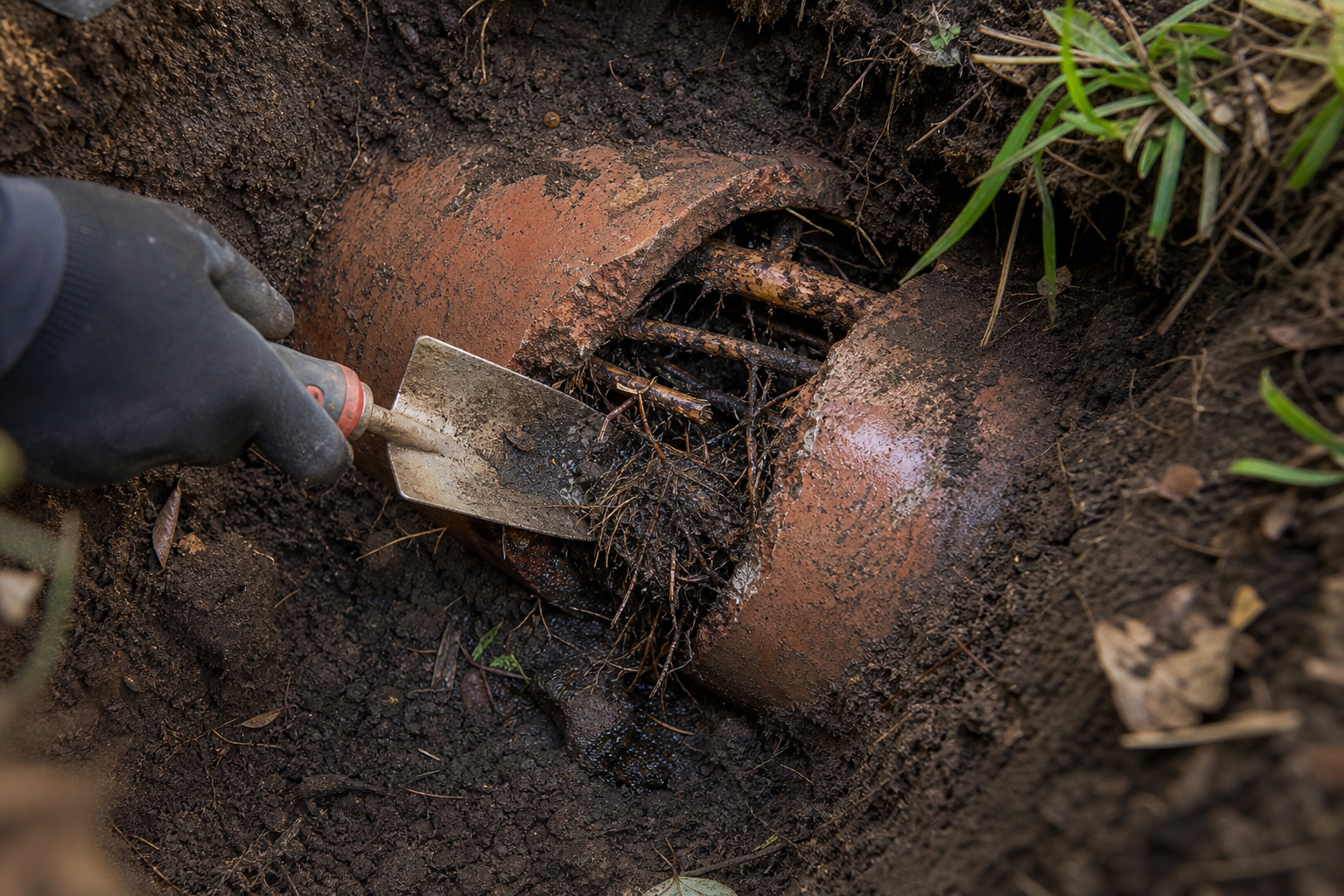
Sewer line root intrusion exposed by reduced flow capacity — heavy rain pushes additional load through sewer lines, exposing borderline blockages that weren’t symptomatic during dry conditions. Common in pre-1970 housing with original clay sewer lines and mature trees nearby.
External tap fittings shearing under wind load — improperly secured external taps can shear at the wall fitting under wind-driven debris impact. Burst pipe damage at the tap location.
Suburb-specific patterns
A few patterns that vary across the Sydney metro:
Eastern Suburbs (Bondi, Coogee, Maroubra, Vaucluse): Beach exposure means salt-air corrosion has often weakened external fittings. Storm season exposes these failures. Replacement with marine-grade brass extends service life.
Inner West (Newtown, Glebe, Marrickville, Leichhardt): Combined sewer/stormwater systems mean backup risk during heavy rain. Mature street trees mean gutter clearance is critical.
North Shore (Mosman, Cremorne, Lane Cove): Steep block geography concentrates surface runoff. Surface drain capacity often inadequate for major events; check council records for flooded-property history.
Northern Beaches (Manly, Dee Why, Mona Vale): Coastal exposure combined with pumped stormwater systems in low-lying areas. Pump maintenance is critical during storm season.
Western Sydney (Penrith, Liverpool): Reactive clay soils mean significant ground movement after major rain events. Slab leaks from buried pipework being shoved sideways typically appear 12-24 months after big wet seasons.
Hills District (Castle Hill, Baulkham Hills, Kellyville): Newer housing stock generally storms-up well, but septic-system properties on the rural fringe (Glenhaven, Galston, Dural) can experience capacity failure during sustained rain.
Sutherland Shire (Cronulla, Engadine, Sutherland): Mix of slab-on-ground and brick-on-pier houses; drainage adequacy varies significantly by build era.
What we do during storm events
For context on what to expect from emergency plumbing service during major events:
- Dispatch desk staffing doubles during peak hours (typically the first 12-24 hours of a major rain event)
- Additional on-call plumbers brought in from rotation
- Triage prioritises active leaks (water still flowing) over intermittent issues
- Standard ETAs typically extend to 2-4 hours during peak call volume
- Same standard emergency rate maintained — no surge pricing
- Honest communication about wait times rather than overpromising
The honest answer during a major storm is “we’ll get there as fast as we can; here’s a realistic ETA; here’s what to do in the meantime.” That’s more useful than an unrealistic promise.
Final word
Sydney’s wet season is going to happen every year. The plumbing emergencies it triggers are largely the same year after year, and largely preventable with the October checklist above. Sixty minutes of preparation in September prevents most January call-outs.
Walk the checklist in early October. Save the document. Repeat annually. The economics work strongly in favour of prevention. And if a storm does catch you off-guard, save the guide on what to do when a pipe bursts alongside our burst pipe repair Sydney number.