
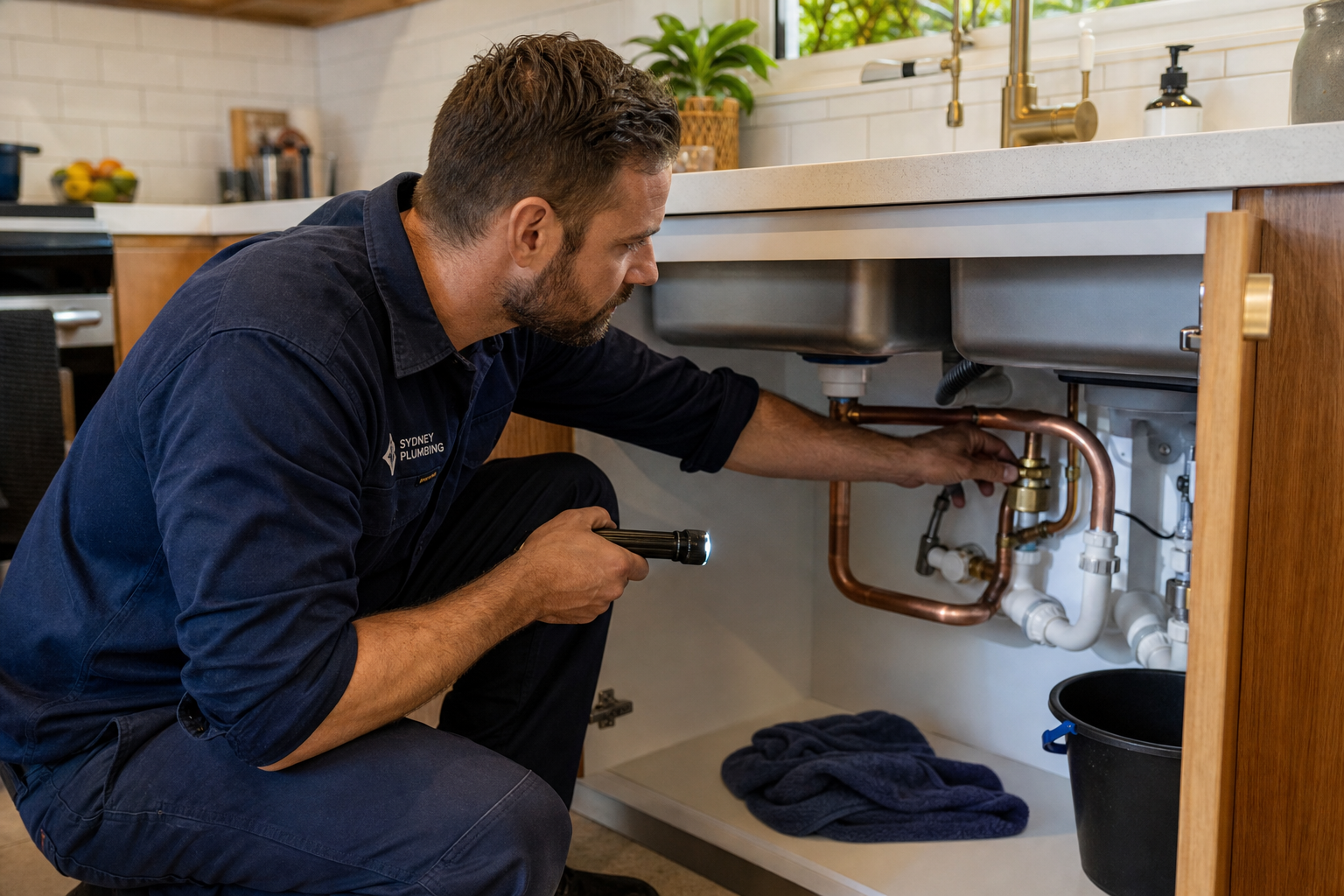
A burst 15mm copper line at 500 kPa supply pressure (standard Sydney mains) sprays roughly 80 litres of water per minute. A flexi-hose under your kitchen sink does the same. Five minutes of unchecked flow puts 400 litres of water through your floors. Ten minutes dumps 800 litres — enough to write off the carpet in three rooms, saturate the underlay, and start working on the structural framing.
The good news: the immediate response isn’t complicated. The bad news: most Sydney homeowners have never tested the steps before they need them.
This guide is the playbook our dispatchers walk through with customers on the phone every week. Once the immediate situation is under control, our burst pipe repair Sydney team will diagnose and fix the root cause fast.
Step 1 — Shut off the supply at the meter (under 60 seconds)
Sydney Water meters sit inside a small in-ground green box at the front boundary, usually near the footpath. Lift the lid. The meter is the dial-faced unit; the shut-off valve is the lever or tap on the house-side of the meter (the side away from the road).
Rotate the lever 90 degrees so it’s perpendicular to the pipe. Done.
For apartments, the unit shut-off valve is typically in the laundry, bathroom, or kitchen — often behind a removable inspection panel. The strata building may also have a riser shut-off but that’s usually inaccessible without the building manager.
Do this now, while you’re not in an emergency: go and find your shut-off valve. Take a photo. Test that you can turn it. The night your kitchen flexi-hose lets go is not the time to be Googling “how does a Sydney water meter work.”
Step 2 — Cut the power if water has reached anything electrical
If you can see water touching power points, light switches, ceiling fittings, the switchboard, or any appliances, shut off the main switch at the meter box.
The meter box is usually:
- Front of house, ground floor, in a recessed grey or beige panel
- Inside hallway near the front door (older terraces)
- In the laundry or garage (newer builds)
- In the basement or ground-floor common area (apartments)
Open the door. Identify the main switch (usually the largest labelled switch at the top, often labelled “MAIN SWITCH” or “NORMAL SUPPLY”). Flick down. Power is off.
If the water hasn’t reached anything electrical, leave the power on — you’ll want lights to navigate by.
Step 3 — Move soft furnishings clear of the water spread
Wet-area damage compounds as water sits. The first ten minutes matter most for damage mitigation. Drag rugs out. Lift cushions. Move books, electronics, and shoes off the floor. Pull furniture legs out of the spread zone.
Don’t try to mop up while water is still flowing. That comes after the supply is isolated.
Step 4 — Photograph everything before clean-up
This is the one that emergency-mode brains forget and that costs homeowners thousands at the insurance claim stage.
Before you mop, before you move things, before the plumber gets there, take photos:
- The visible failure point (if accessible)
- The full water spread across affected rooms
- Any damaged personal items in their original position
- Standing water depth against a recognisable reference (skirting board, doorframe)
- Wet ceiling sections from below if water has spread upward
Time-stamped phone photos are accepted by every major NSW insurer (NRMA, AAMI, Allianz, Suncorp, CommInsure). They form the foundation of the contents-damage portion of the claim.
Step 5 — Ring an emergency plumber
Once supply is off and damage is mitigated, you’ve got time. The emergency is no longer escalating. You can now choose a plumber properly rather than ringing the first Google ad. Our 24 hour emergency plumber Sydney team responds across all Sydney suburbs any hour of the day.
What to ask before agreeing to dispatch:
- Are you NSW Fair Trading licensed? (Get a licence number; verify at nswfairtrading.gov.au)
- What’s the standard hourly rate, and is there a separate call-out fee?
- Will the rate change because it’s after hours / weekend?
- What’s your ETA to my suburb?
- Will I get a written quote before any work starts?
Reputable operators answer all five questions without hesitation and confirm everything by text within minutes of dispatch.
Step 6 — While you wait
A few things worth doing in the gap between booking and arrival:
Locate the failure point if it’s hidden. Walk the house. Check ceilings (water-stained patches, sagging plasterboard). Check under sinks, behind toilets, around hot water units. Listen for hissing or running water sounds with the supply still off — if you hear anything, the failure may be downstream of a closed valve and worth reporting.
Drain residual pressure. With the supply off, open the highest cold tap in the house (usually a bathroom basin on the top floor). This drops the pressure trapped in the lines and slows or stops any continuing drip from the burst point.
Move belongings out of the wet zone entirely. Even after the flow stops, residual water keeps wicking into materials. Anything you can keep in dry rooms saves remediation cost later.
Locate a torch. If you’ve shut off the power, you’ll need it.
Step 7 — When the plumber arrives
A reputable Sydney emergency plumber will:
- Introduce themselves, show their licence card
- Inspect the failure point and surrounding area
- Quote the repair in writing — labour, parts, total — before touching anything
- Wait for your approval before beginning
- Complete the repair, pressure-test the line
- Run all taps to confirm the system is operational
- Issue an itemised invoice on the spot
- Email you the warranty paperwork (12 months on workmanship is the NSW industry standard)
- Provide additional documentation for your insurance claim if needed — at no extra charge
If anything in that sequence is skipped, missing, or evasive, you’ve got grounds to refuse and ring another operator.
What not to do
A few things that occasionally make a bad situation worse:
- Don’t apply putty, tape, or epoxy to a pressurised line. It doesn’t work and the pressure builds behind the patch until the pipe fails again — usually somewhere harder to access.
- Don’t run a wet-vac into anything electrical. If power is on and water is near the switchboard, leave it for the plumber and electrician.
- Don’t refuse documentation. Even if you don’t think you’ll claim on insurance, take the paperwork. Slow leaks discovered weeks later sometimes connect back to the original event.
- Don’t accept verbal quotes for major work. Anything beyond a $200 flexi-hose replacement should be in writing before work begins.
Sydney-specific notes
A few patterns we see across the Sydney metro that are worth knowing about in advance:
Inner West and Eastern Suburbs heritage homes: Original galvanised iron supply lines from pre-1960 builds pinhole internally over time. Failures often appear at joins and elbows, typically in walls behind kitchen and bathroom fixtures. A burst in one location often means the rest of that section of line is within months of the same failure.
Western Sydney slab-on-ground builds: Buried hot water lines under slabs are vulnerable to clay-soil movement during wet/dry cycles. Slab leaks often present as a hot spot on the floor before any visible water appears. If you’ve noticed a warm patch on the kitchen floor in the last few weeks, mention it to the plumber.
North Shore and Northern Beaches salt-air zones: External copper fittings and hose taps within ~5km of the coast pit and corrode faster than equivalent inland fittings. Outdoor hose tap failures are more common here than anywhere else in the metro.
Strata buildings (CBD, Surry Hills, Bondi, Chatswood, Parramatta): Riser leaks in apartment towers can flood multiple units below yours before anyone notices. If you’ve had a sudden water bill spike or seen damp marks on your ceiling, it might originate from the unit two or three floors above.
Final word
The damage from a burst pipe scales fast — every minute matters in the first ten. The damage from the response scales just as fast — the wrong plumber can turn a $400 emergency into a $4,000 write-up.
Print this guide if it helps. Tape the meter location and shut-off photo to the inside of your kitchen cupboard door. Test the valve once a year. Save a Sydney emergency plumber number in your phone under “emergency plumber” so you don’t have to think clearly to find it at 3am.
The ten minutes you spend preparing now save thousands when the flexi-hose finally lets go. Read our pricing guide to know what fair rates look like before you’re in that situation.