
How we fix it
About this service in Sydney
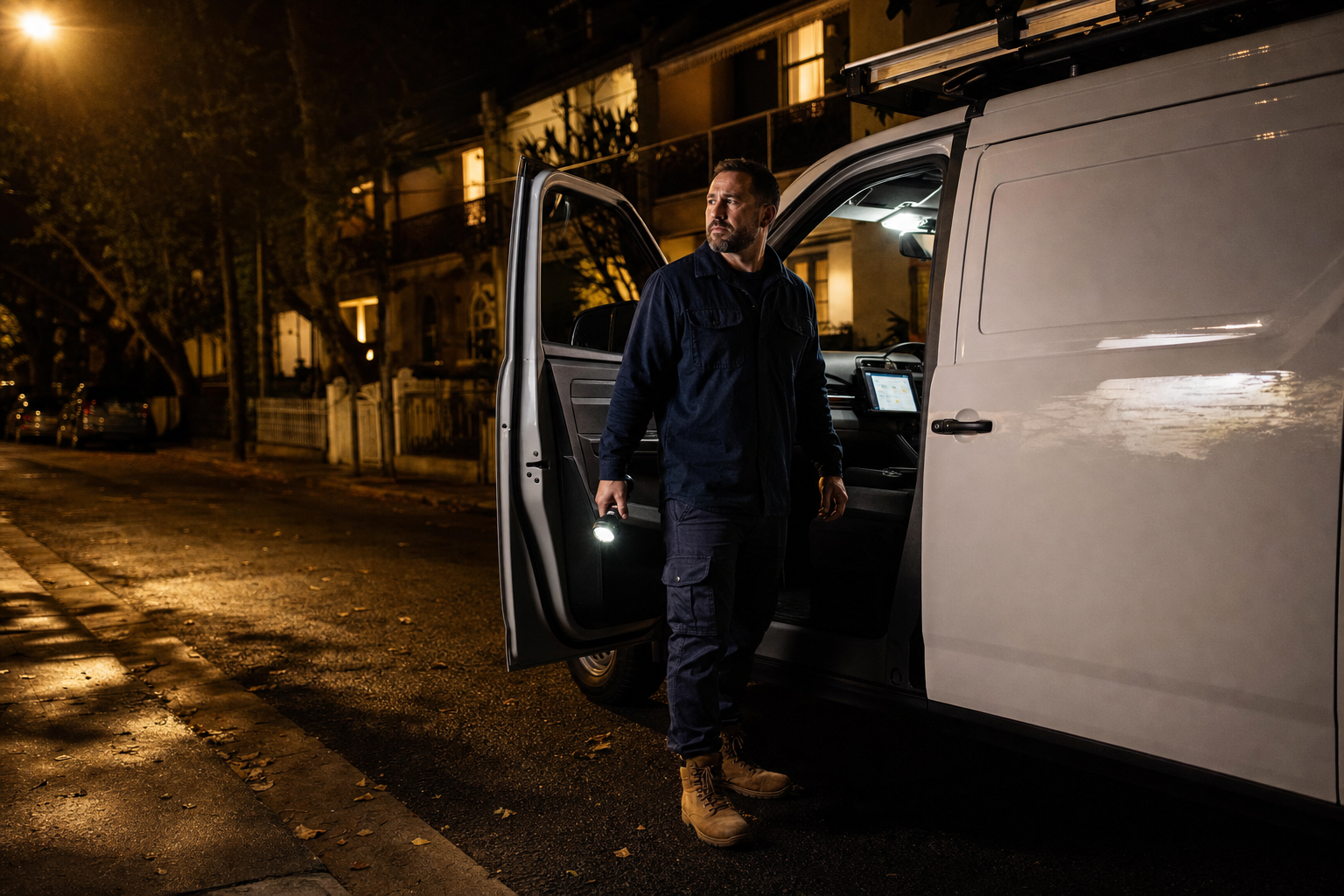
The 24/7 emergency plumber market in Sydney has a quiet problem: plenty of companies advertise round-the-clock service, but only a fraction actually run rostered overnight crews. The rest take your 3am call into a voicemail or an answering service, then ring around trying to find a freelance contractor who’ll come out — at a significantly inflated rate to cover the inconvenience.
The result is unpredictable response times, surprise pricing, and plumbers showing up grumpy because they’ve been pulled out of bed for double pay. We don’t run that model.
How our 24/7 service actually works
Two dispatchers cover the overnight shift (10pm to 6am Sydney time) seven nights a week. They monitor incoming quote form submissions live — every form gets a human response within 15 minutes regardless of the hour. Quote text goes back with a real range, a real ETA, and the name of the plumber dispatched.
On the road, plumbers work rostered overnight shifts (typically a five-night-on, three-off pattern) covering nominated zones across the Sydney metro. The closest available van to your suburb gets the job; average door-to-door at 3am is faster than during business hours because there’s no traffic.
Pricing is the same standard emergency rate any hour of any day for genuine emergencies. The after-hours premium ($180-300/hr) only applies when you specifically book non-urgent work outside business hours for convenience — a leaky tap you want sorted overnight, a toilet seat replacement at 9pm Sunday, that kind of thing.
Why “no after-hours surcharge for emergencies” makes commercial sense
Plenty of customers ask how we can offer 24/7 standard-rate emergency service when most competitors charge double or triple. Three reasons:
Predictable cost structure. Our overnight plumbers are on rostered shifts at standard wages plus shift loadings. The cost is roughly the same per hour as daytime work — slightly higher due to penalty rates, slightly lower due to no traffic and faster job completion. Net effect: about even.
Higher conversion on emergency calls. When your pricing is genuinely competitive at 2am, more emergency calls convert to actual jobs — customers don’t ring around comparing surge prices. We do more volume at standard margins instead of fewer jobs at inflated margins. Better for everyone.
Reputation compound interest. Sydney homeowners remember which emergency plumber didn’t gouge them. A burst pipe at 3am that gets sorted at standard rate becomes a referral and a five-star review; the same call at triple rate becomes a one-star and a Reddit post. We’ve built the business around the former.
The one place we charge the after-hours premium is non-urgent work specifically scheduled outside business hours. If a renovator wants us on-site at 8pm because that suits the construction schedule, that attracts the after-hours rate. Fair to both sides.
When 24/7 actually matters
Most plumbing problems can wait until morning. The genuine 3am-call scenarios are narrower than most people assume:
- Active water flow you can’t isolate. A burst pipe still gushing with the meter shut off (rare — usually means the meter valve itself is failing). A flexi-hose blowout you’ve shut off at the isolation valve but with water seeping past. An outdoor garden tap ruptured at the wall.
- Sewage backup. Sewage rising through floor drains, toilets, or showers. Health hazard inside hours; risks contaminating walls and flooring permanently if left overnight.
- Gas leaks. Always emergency. Always now. See our gas leak emergency guide for the six-step sequence before you ring.
- No hot water with vulnerable household members. Newborns, young children, elderly residents, anyone unwell. A cold winter morning with no hot water for a 6am school run is genuine emergency territory.
- Flooding threatening electrical or structural. Water near switchboards, water threatening structural timber, water on ground floor of a multi-storey property. Don’t wait.
- Storm damage during the wet season (October to March in Sydney). East Coast Lows generate plumbing emergency volume that can spike 5x normal weekday levels.
If you’re staring at any of those, ring us. If you’ve got a slow drip under the laundry basin or a toilet seat with a wobbly hinge, save the call for morning — your bank account will thank you.
Storm season — Sydney’s busy time
Sydney’s wet season runs roughly October to March, with peak emergency call volume during East Coast Lows (intense low-pressure systems that develop off the coast and dump significant rainfall in short bursts). La Niña years amplify the pattern; the 2022 and 2025 events both generated unprecedented call volumes for emergency plumbers across the metro.
Storm-related emergencies cluster around predictable patterns:
- Roof and gutter overflow sending water down internal pipework in unexpected ways
- Storm surge into sewer overflows causing backups even in well-maintained homes
- Power outages disabling sump pumps in basement areas (particularly in older inner-city homes with subterranean plumbing)
- Tree damage snapping above-ground gas and water lines
- Lightning strikes damaging hot water unit electronics
We staff up for the wet season — additional overnight dispatchers, extra plumbers on call, multiple base locations across the metro to keep response times reasonable when call volume spikes. During major events we sometimes triage by severity (active leaks first, repairs that can wait second), but we don’t drop service.
Public holidays and Christmas
Christmas Day. New Year’s Day. Australia Day. Easter Sunday. ANZAC Day. Public holidays generate their own emergency pattern — usually because households are running washing machines, dishwashers, and showers at higher-than-normal frequency for visiting family.
Our position on holiday pricing is straightforward: same standard emergency rate for genuine emergencies on every public holiday of the year. No Christmas surcharge, no Boxing Day premium, no New Year’s “convenience fee.” If you’re staring at sewage on Christmas morning, that’s already bad enough without the bill being weaponised against you.
Compared to competitors
A quick reality check on what’s typical in the Sydney market versus our pricing:
- Typical Sydney emergency plumber after-hours rate: $250-400/hr for after-hours work; some quote $500+/hr for public holidays
- Typical call-out fee charged on top of the hourly rate: $80-200 (we don’t charge one)
- Typical “first hour” loading: many companies bill the first hour at 1.5x or 2x normal rate; we don’t
- Typical surge pricing during storms: some companies apply 20-50% surge during high-demand periods; we don’t
We’re not the cheapest in the market; we’re middle-of-pack on weekday daytime rates and significantly cheaper than the market on nights, weekends, and holidays for genuine emergencies. The maths works out in your favour exactly when you most need a plumber.
What you can do while we’re on the way
If you’ve submitted the quote form and a plumber’s been dispatched, three things to do (in order):
- Isolate the supply — water at the meter for leaks, gas at the meter for gas smells. Photos of where the meter sits in your yard, taken now during a non-emergency, are gold for future calls.
- Move stuff out of the way — clear a path to the affected area, move soft furnishings out of water reach, lift rugs, get towels down on the worst spots.
- Document the damage with your phone — wide shots of the affected room, close shots of the failed component, the time stamp on the photos. All useful for insurance claims later.
If you can’t find your meter, can’t shut off the supply, or are worried about safety, ring the dispatcher line that came in your quote text. We’ll talk you through it while the plumber drives.
Read our how to turn off water mains in Sydney guide — it covers every Sydney property type including apartments, strata, and houses with non-standard meter locations. For a full breakdown of our honest pricing, see the pricing page.