
How we fix it
About this service in Sydney
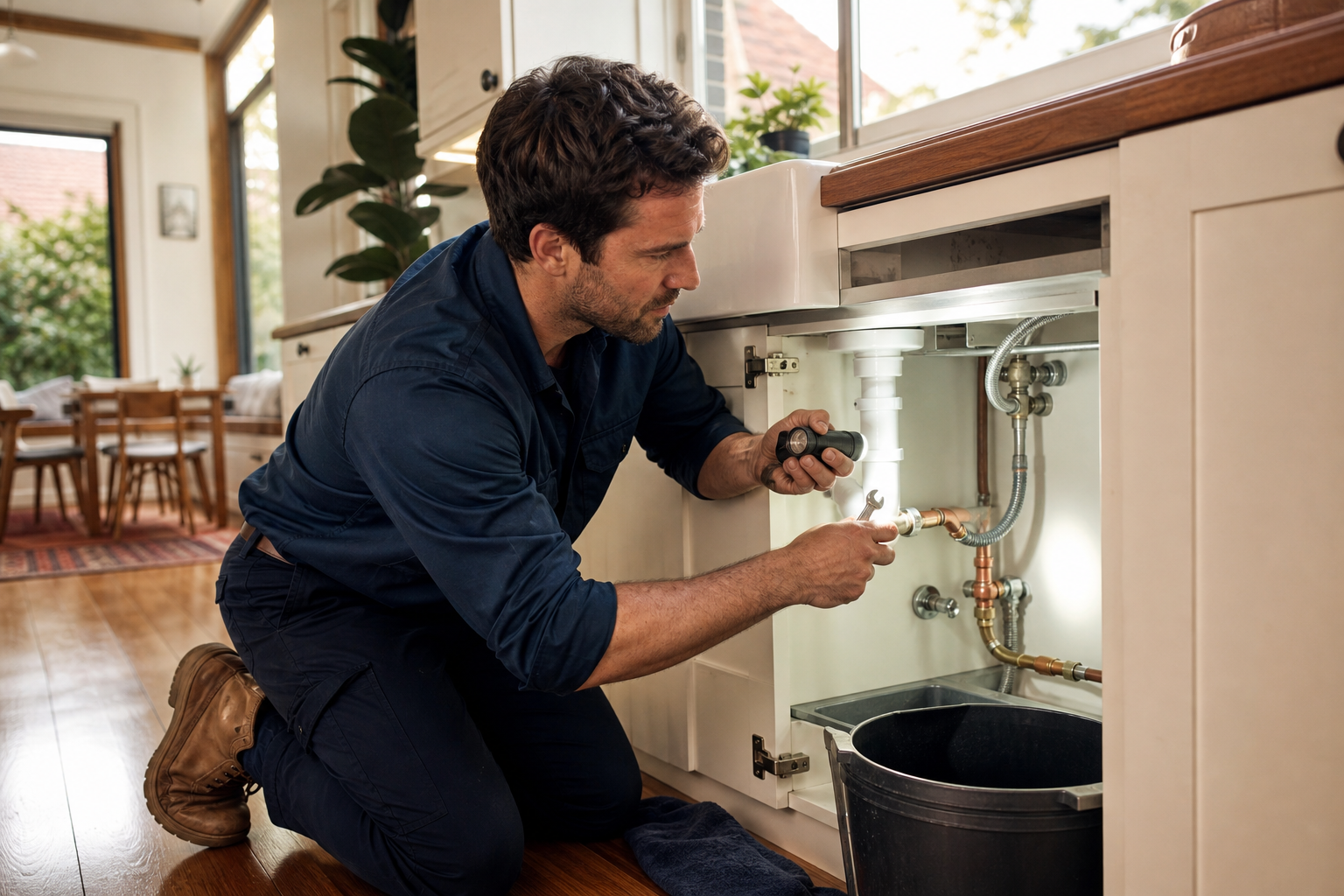
It’s the call we get at three in the morning more than any other: a copper joint giving way under the bathroom vanity, water pooling across the floorboards, no idea where the shut-off valve is. By the time we arrive, the carpet’s saturated and the gyprock under the sink is starting to crumble.
Burst pipes aren’t subtle. They’re loud, fast, and expensive — every minute the water keeps flowing is more damage to floors, walls, and contents. The first job on every burst pipe call we attend is to isolate the supply and stop the bleeding. Diagnosis and repair come second.
What “burst pipe” actually covers
The phrase gets used loosely. In practice, four different failure modes all present as the same problem: water where there shouldn’t be water.
Joint failure — solder joints on copper pipework, push-fit fittings on PEX, threaded joints on galvanised. The most common emergency call. Often triggered by water hammer (a hot tap shut hard enough to shock the system), thermal stress (hot pipe expansion against rigid fittings), or simply age fatigue. Repair is usually cut-out-and-replace with a new fitting.
Pinhole leaks — small perforations through the pipe wall itself, not at a joint. Almost always corrosion-driven. Common on:
- Galvanised steel pipework over 50 years old (the original Federation, Victorian and early post-war housing stock across Newtown, Glebe, Paddington, Marrickville)
- Copper pipes in coastal suburbs where salt-laden air has accelerated pitting from the outside (Bondi, Coogee, Manly, Mona Vale)
- Copper pipes carrying highly chlorinated Sydney Water that’s sat in a badly-vented hot water system long enough to chew through the inside
Slab leaks — leaks in copper water lines that run under the concrete slab of newer Sydney homes (post-1980 brick veneer, common across Western Sydney and the Hills District). Symptoms: warm patches on the floor, unexplained sounds of running water, mould smells in carpets. Detection is the hard part; repair options range from concrete cutting (cheaper, more disruption) to abandoning the slab line and routing a new pipe through ceiling space (more expensive, less mess).
Catastrophic main breaks — the supply line between your meter and the house ruptures. Usually trenched poly pipe damaged by tree roots, a shifting clay-soil base in Western Sydney, or contractor digging gone wrong. Water hits the surface in the front yard. Sydney Water is sometimes responsible for the section before the meter — we’ll tell you which side of the boundary the rupture’s on so you know who’s footing the bill.
Why Sydney plumbing fails differently to the rest of Australia
Two things make Sydney burst pipes a regional specialty.
Salt air on the coast. The Eastern Suburbs and Northern Beaches sit in an aerosol corrosion zone — within about 5 km of the coast, copper cladding around hot water systems and outdoor gas lines pits and corrodes within 8-10 years. The pipework looks fine until it doesn’t. We’ve replaced hot water lines in Bondi homes that had visible green patina across the entire copper run; the homeowner had no idea anything was wrong until water came through the bathroom ceiling.
Reactive clay soils inland. Western Sydney, Hills District, and parts of Sutherland Shire sit on clay that expands during wet seasons (every La Niña year — like the 2022 and 2025 events) and contracts during dry spells. PVC sewer mains and copper water lines under slabs get shoved sideways by the soil movement, opening up old joints and cracking fittings. Most slab leaks we attend in Castle Hill, Kellyville and Penrith trace back to one or two big wet seasons two or three years prior.
A plumber who’s worked Sydney for a decade knows to check the suburb postcode before quoting on a “simple” leak. The fix in Bondi isn’t the fix in Penrith.
Our repair approach
Cut, replace, test, sign off. Every burst pipe call follows the same sequence:
- Isolate at the meter. If we can do it at a closer service valve (under the sink, behind the dishwasher), we will, so the rest of the house keeps running.
- Diagnose — visual first, then acoustic detection if the leak is hidden, then thermal imaging if a hot water line is suspected.
- Quote in writing. Even at 3am. You see the price and approve before the cutter comes out of the toolbox.
- Cut out the failed section with enough margin either side that we’re working on healthy pipe. No fitting goes onto compromised substrate.
- Replace with the same material as the original where possible (copper to copper, PEX to PEX). Mixing metals creates electrolytic corrosion and a new leak inside two years.
- Pressure test the repaired section, then the whole branch, then the whole house. Hold pressure for at least 5 minutes. If it drops, we keep looking.
- Document for insurance. Photos before, photos after, written report on letterhead. Most NRMA, AAMI, Allianz and Suncorp claims need this exact paperwork to process.
Materials we carry
Most Sydney emergency plumbers stock copper and PEX. We also carry:
- Polybutylene (PB) push-fit fittings for the seventies-renovation housing across the Inner West and parts of the North Shore. PB pipes shatter rather than leak; the only safe fix is a section re-pipe in PEX with proper crossover fittings.
- Galvanised dies and threaders for the rare jobs where re-piping isn’t an option (heritage-listed buildings, where any change to original fabric needs council approval).
- Push-fit emergency couplings (SharkBite-style) for true break-glass-in-emergency repairs where time matters more than longevity. We’ll always note when we’ve used a temporary fitting and recommend a permanent fix.
- Brass barrel unions for connecting dissimilar metals — necessary when an old copper hot water line meets a new PEX cold-water section in a partial-rebuild scenario.
Insurance and burst pipe damage
Most Sydney homeowners are surprised to learn that home and contents insurance generally does cover the water damage from a burst pipe — saturated carpets, ruined furniture, stained ceilings — but does not cover the cost of fixing the pipe itself. Read our full guide on what NSW insurance covers for burst pipes for the insurer-by-insurer breakdown. The pipe is treated as a maintenance item; the damage to your stuff is treated as a sudden unexpected event.
To make a successful claim, you need:
- A dated, itemised invoice from a licensed plumber (with NSW Fair Trading licence number visible)
- Photos of the failed pipe before repair and after repair
- A written description of what failed and likely cause
- The licence number independently verifiable at fairtrading.nsw.gov.au
We supply all of the above as standard with every burst pipe call. If your insurer needs anything else (a separate report on letterhead, a witness statement, a comparison quote), let us know — we’ll provide it at no extra charge.
When DIY is the wrong move
We get the temptation. The hardware store is open, push-fit fittings look easy, and there’s a YouTube video for everything. Three reasons to hold off:
- Insurance. Any unlicensed plumbing work voids the relevant section of your home insurance policy in NSW. If your DIY fix fails six months later and floods the upstairs neighbour’s apartment, you’re personally liable for the lot.
- Strata. Strata bylaws across most Sydney apartment buildings prohibit unlicensed plumbing work in any common-property pipework (which includes most stuff inside walls). Penalties from the body corporate can be steep.
- Unseen damage. A pipe that’s failed once almost certainly has related stress on adjacent fittings. A licensed plumber checks the surrounding system; a DIY patch only fixes what you can see.
Tightening a leaking flexi-hose at the wall isolation valve is fine. Cutting and rejoining pressurised water lines is not.
Not sure if it’s a burst or a slow leak? Read our burst pipe vs leaking pipe guide for the 30-second diagnostic. For pricing, see our emergency plumbing cost guide.