
How we fix it
About this service in Sydney
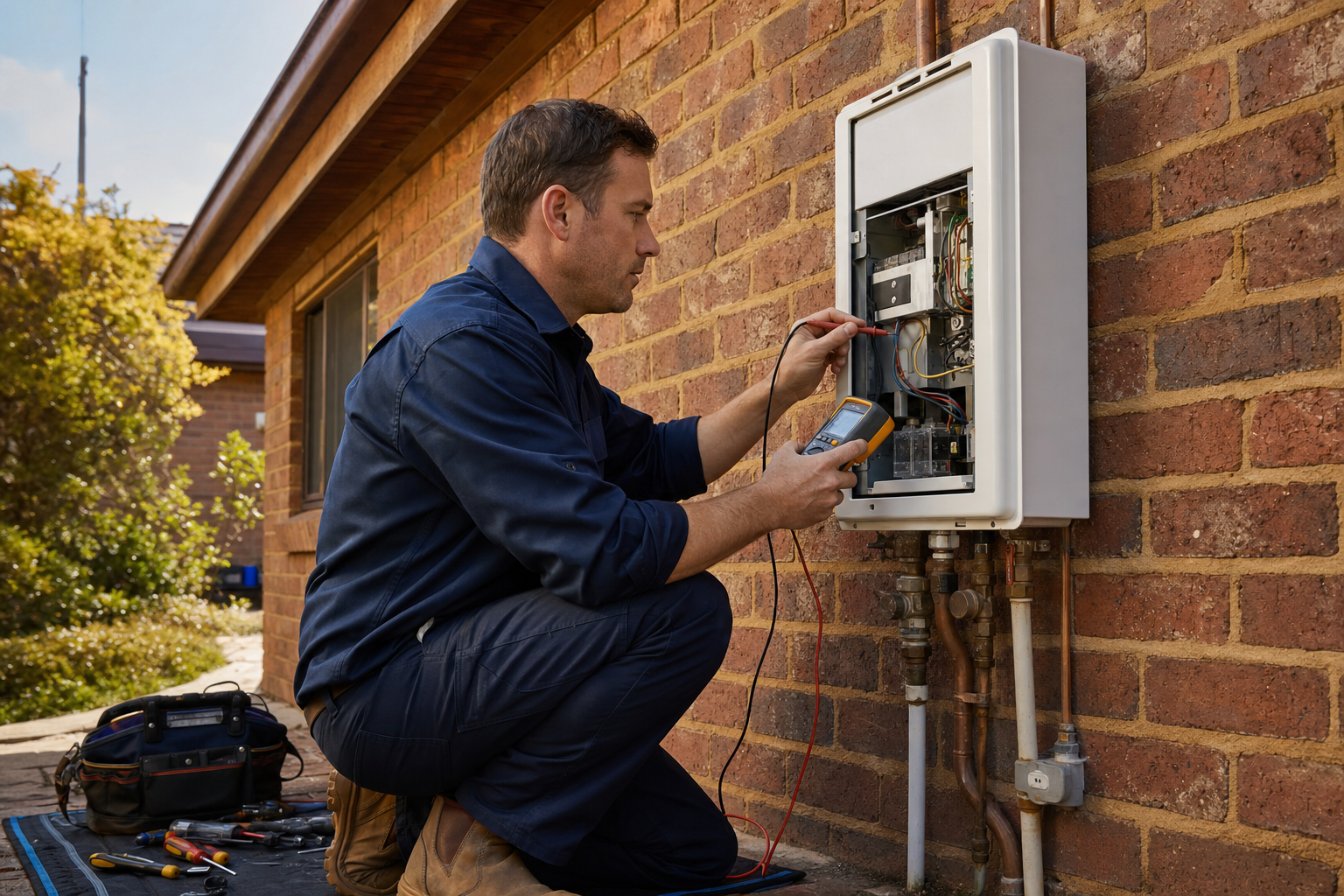
It always picks the worst moment. Saturday morning before the in-laws arrive. Tuesday at 6am with a cold school run ahead. The middle of an East Coast Low when nobody’s leaving the house anyway. Hot water systems have a knack for failing at peak inconvenience.
The good news: most hot water emergencies in Sydney fall into a handful of common failure modes that we’ve seen hundreds of times. Roughly two-thirds of our emergency hot water calls get fixed in the first visit with parts already on the van. The remaining third usually mean the unit itself has reached end-of-life and a replacement is the right call. Read our complete hot water system failure guide to understand the four unit types and their common failure modes.
What’s actually wrong with your hot water
Five failure patterns cover most of what we attend across Sydney.
Element burnout (electric storage units). The heating element inside the tank fails — usually after 6-10 years of service, sometimes earlier in hard-water areas (Western Sydney has noticeably harder water than the inner-ring suburbs). Symptoms: water goes lukewarm and stays that way, or fully cold. Cheap repair: replacement element plus thermostat, typically $200-400 done in 60-90 minutes.
Thermostat failure (electric storage). The thermostat that controls the element gives out. Same symptoms as element burnout but cheaper to fix. Worth diagnosing properly before replacing the element — we’ve swapped plenty of perfectly good elements because the actual fault was a $40 thermostat that took 5 minutes to replace.
Gas valve or control board failure (gas instantaneous). Continuous- flow gas units (Rinnai and Rheem dominate this category in Sydney) rely on a gas valve and electronic control board to fire on demand. When either fails, the pilot won’t stay lit, the burner won’t ignite when you open a hot tap, or the unit cycles on and off without heating properly. Repair is moderate ($350-650) and usually done same visit if the right control board is in stock.
Pressure relief valve failure (storage units). The PRV is a safety component that releases water if tank pressure or temperature gets too high. When it sticks open, water continuously dribbles from the overflow pipe; when it sticks shut, you’ve got a real safety problem. Replacement is straightforward — typically $220-380 — and required under NSW compliance regulations on any storage tank.
Tank rust-through (electric and gas storage, end-of-life). The tank itself fails — water through the cladding, water on the floor, no amount of repair will fix it. Storage tanks are designed for 8-12 years; coastal-zone units often fail sooner. The only option is replacement. We quote like-for-like (Rheem to Rheem, Rinnai to Rinnai) or heat-pump upgrade with a clear payback calculation.
Why Sydney’s hot water systems fail differently
A few regional patterns show up over and over.
Coastal corrosion — Eastern Suburbs and Northern Beaches. Salt- laden air pits the outer cladding and external fittings. Within 8-10 years, even premium units (Rheem Enviro, Rinnai INFINITY) show visible corrosion at every fitting and valve. We see it most in Bondi, Coogee, Manly, and Mona Vale. Marine-grade fittings on replacement install extend service life noticeably.
Hard water build-up — Western Sydney, parts of the Hills District. Sydney Water draws from different catchments and treatment plants for different parts of the city; the supply to Penrith, Liverpool and Blacktown carries higher mineral content than the supply to inner-ring suburbs. Build-up coats elements, sediments inside tanks, and reduces unit efficiency over time. Annual flushing (about $120-180) extends unit life by years.
Strata high-rise complications — CBD, Pyrmont, Surry Hills, Bondi Junction. Apartment hot water systems are typically smaller capacity than free-standing house units and often shared across multiple lots in older builds. Replacement requires body corporate sign-off and sometimes specialist access (cranes for top-floor instantaneous units). We’ve done all of it; not a barrier.
Heritage-home installations — Inner West, Eastern Suburbs heritage zones. Installing a modern hot water unit in a Federation or Victorian terrace sometimes needs creative fitting work where the original plumbing wasn’t designed for current standards. Worth getting a specialist quote rather than the cheapest option.
Authorised service for Rheem and Rinnai
Both Rheem (Australia’s largest hot water manufacturer) and Rinnai (the gas instantaneous specialist) operate authorised service agent networks in Sydney. We’re certified for both. Practical implications:
- Warranty repairs are covered under the manufacturer warranty when performed by an authorised agent — we don’t void your warranty by doing the work
- Genuine parts at trade pricing, not aftermarket equivalents that cause secondary failures
- Direct manufacturer support for unusual diagnostic calls — we can ring Rheem or Rinnai tech support during a complex repair
- Compliance certificates issued where required (gas connections, AS/NZS 3500 compliance for replacements)
If your existing unit is Bosch, Dux, AquaMAX or another brand, we still service them — just confirm the brand on your quote form so we can check parts availability before dispatch.
Repair, replace, or upgrade?
The decision tree we walk customers through:
Repair if: unit is under 8 years old, the fault is parts-replaceable, total repair cost is less than 30% of replacement cost. Almost always the right call for the next 3-5 years.
Replace like-for-like if: unit is 8-12 years old, recent failures have been frequent or expensive, your usage pattern hasn’t changed. Predictable cost, predictable performance, predictable lifespan.
Upgrade to heat pump if: unit is over 10 years old, you’re open to higher upfront cost for lower running costs, you qualify for NSW Energy Savings Scheme rebates (most Sydney households do). Payback typically 4-7 years. Quieter, more efficient, future-proofed against gas phase-out announcements.
We quote all three options when relevant so you can decide with full numbers in front of you, not under emergency pressure.
What about gov rebates?
The NSW Energy Savings Scheme provides incentives for upgrading inefficient water heating systems — primarily heat pump systems replacing electric storage. Rebates typically range $500-$1,500 depending on the unit and household circumstances. We handle the paperwork as part of the install if you go that route; you don’t fill in anything yourself.
There’s also a Federal Small-scale Technology Certificate (STC) scheme that applies to heat pump installs. Worth $300-800 in additional rebate value, also handled as part of the quote.
Combined, the rebates often bring the upfront cost of a heat pump install close to the cost of a like-for-like electric storage replacement. Worth asking about during the quote.
What you can check while you wait
If you’ve submitted the quote form and a plumber’s on the way, three quick checks that might save the call-out entirely:
- Check the circuit breaker for the hot water system in your main switchboard. Sometimes a power surge trips the breaker; flicking it back on solves the problem.
- Check the gas supply if you’ve got an instantaneous gas unit — look at the gas meter outside, make sure the valve handle is parallel to the pipe (open). Sometimes maintenance crews shut it off and forget to re-open.
- Check for an obvious leak around the base of the unit. Water on the floor of a storage tank means tank failure (replacement, not repair). Water dripping from the overflow pipe means a stuck pressure relief valve (repair, not replacement).
If any of those resolves it, ring us back and we’ll cancel the dispatch with no charge. If not, we’re already on the way.
For cost guidance before we arrive, see our full emergency plumber pricing guide with exact Sydney 2026 ranges for every hot water repair and replacement scenario.