
How we fix it
About this service in Sydney
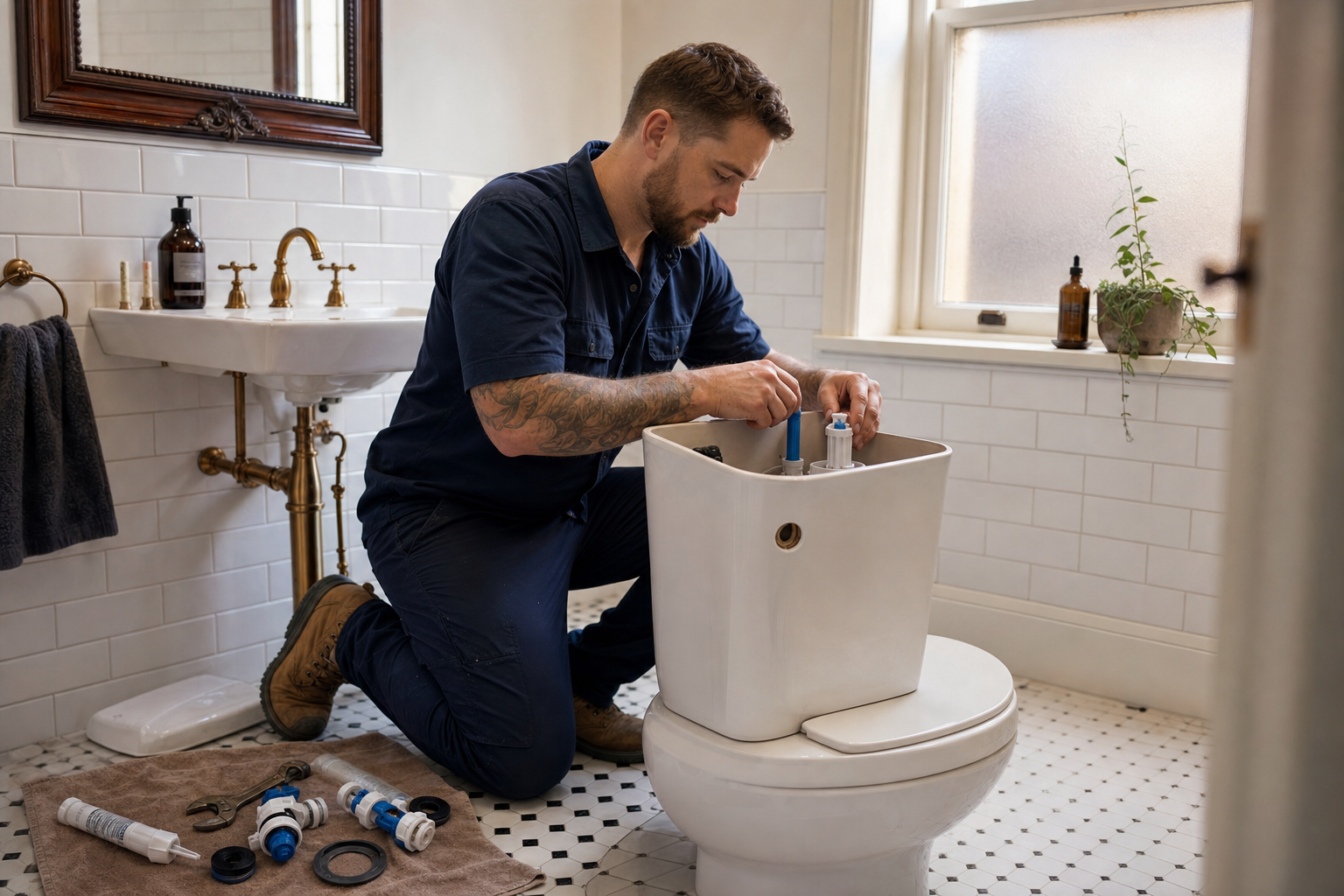
Toilet emergencies are the underrated category. They’re not as dramatic as a burst pipe or as scary as a gas leak, but a toilet that’s overflowing, leaking, or refuses to flush at the wrong moment brings a household to a halt fast. Particularly if it’s the only one in the house.
The good news: about 80% of toilet repair calls we attend across Sydney are quick fixes — cistern internals, seals, S-bend blockages — completed in 30-60 minutes with Caroma parts already on the van. The remaining 20% are bigger jobs (cracked pans, full replacements, common-waste issues in strata buildings) but still straightforward once diagnosed.
Caroma — why one brand dominates Sydney
Walk into almost any Sydney bathroom built or renovated since the late 1980s and you’ll find a Caroma cistern. The Australian-made brand has held the dominant market share for decades, partly through quality, partly through the strength of its dual-flush patent (Caroma invented the modern dual-flush toilet in 1980 — genuinely significant Australian engineering history).
Practical implications when something fails:
- Replacement parts are stocked at every plumbing supplier in the Sydney metro and on every emergency van we run
- Standard fittings mean a Caroma flush valve from 1995 is largely interchangeable with a Caroma flush valve from 2025
- Like-for-like replacements are quick to source and predictable in cost — no waiting on imported parts
If you’ve got a non-Caroma toilet (Roca, Posh, Stylus, Geberit, or imported European units), repairs are still doable but sometimes involve a 24-48 hour parts wait. We’ll tell you upfront whether that’s the case.
What’s actually breaking on your Sydney toilet
Five failure patterns cover most of what we attend.
Flush valve failure (cistern internals). The single most common toilet emergency. The flush valve (the rubber-and-plastic mechanism that releases water from the cistern into the pan when you press the button) wears out — usually after 10-15 years of service, sometimes sooner in hard-water suburbs where mineral build-up accelerates deterioration. Symptoms: weak flush, partial flush, continuous water trickle from the cistern into the pan. Cheap repair: $220-380 done in 30-45 minutes with stock Caroma parts.
Fill valve failure (cistern internals). The fill valve refills the cistern after each flush. When it fails, the cistern either won’t fill (no water for next flush), overfills (water running constantly through the overflow into the pan), or fills slowly (extended re-fill times). Same repair cost band as flush valve — often we replace both at once if the unit is older than 10 years because the second failure is usually months away.
Seal failure at the base (wax or silicone). The toilet pan sits on a wax ring or silicone gasket that seals the connection between the pan and the floor flange. Over time the seal degrades, allowing small water and waste seepage into the floor cavity below. Symptoms: wobbly pan, sewer smell that won’t clear after flushing, damp patch on the floor around the base. Repair requires lifting the pan, replacing the seal, reseating — typically $280-450 for the job.
Cracked cistern or pan. Porcelain damage from impact (a mishandled cleaning brush, kids climbing on the cistern lid), thermal stress (rare, but happens with extreme cold snaps in Western Sydney), or simple age fatigue. Replacement is the only viable option once porcelain cracks. Like-for-like Caroma replacement runs $450-850 for cistern only, $850-1,800 for full pan and cistern.
S-bend blockage. The S-bend (the curved trap built into the toilet base) collects paper, hair, and any foreign objects flushed accidentally. Most clear with mechanical hand auger from the pan side. Stubborn blockages occasionally require lifting the pan to access from below — adds about $150 to the repair cost.
Sydney-specific toilet quirks
A few patterns worth knowing about.
Heritage homes (Newtown, Glebe, Paddington, Balmain, Surry Hills) often have toilets installed when the bathroom was retrofitted into what was originally an external WC — meaning the soil pipe runs in unusual locations and the floor flange isn’t always where you’d expect. Replacement work sometimes needs creative fitting.
Strata buildings (CBD, Pyrmont, Bondi, Mascot) share waste risers between multiple lots stacked vertically. A blockage at your unit can have its actual cause two floors above; a blockage in someone else’s unit can affect yours. CCTV documentation is gold for sorting out the body corporate vs lot owner cost split.
Apartment in-wall cisterns (post-2010 builds in Pyrmont, Surry Hills, Bondi Junction) hide the cistern inside the wall behind the toilet pan. Repairs require accessing through a removable wall panel, which sometimes adds to labour cost but is otherwise standard work.
Older 11L single-flush toilets in pre-1990 homes use considerably more water per flush than modern dual-flush units. Replacement to a modern 4.5/3L dual-flush typically pays for itself in water bill savings within 5-7 years for a household of four. Worth considering during any major repair.
Repair vs replace — when each makes sense
Most calls we attend are repair scenarios. The decision tree:
Repair if the cistern internals are the only issue, the porcelain is intact, the seal is fine, and the unit is under 15 years old. Total repair cost typically $220-450 covering the next 5+ years of service.
Replace if the porcelain itself is damaged (crack in the pan or cistern), the unit has had three or more failures in the last two years (the next failure is around the corner), or you’re already renovating the bathroom and the timing makes sense.
Upgrade if you’ve got an older single-flush unit using 11L per flush — the water bill savings from a modern 4.5/3L dual-flush typically justify the upgrade cost within 5-7 years for a typical household.
We quote both repair and replacement when relevant so you can decide with full numbers in front of you, not under emergency pressure.
Strata building considerations
About a quarter of our toilet repair calls are in strata properties across the Sydney CBD, Pyrmont, Surry Hills, Bondi Junction, and similar high-density suburbs. The cost-allocation rules are usually straightforward but worth understanding:
- Lot owner pays for the toilet itself (pan, cistern, internals, isolation valve) and the branch waste pipe up to the common-property riser
- Body corporate pays for the common-property waste riser, the building’s main soil stack, and the connection to the street sewer
- Ambiguous cases (a blockage where the cause is downstream of your apartment but upstream of the riser) generally fall to the body corporate but sometimes need CCTV documentation to confirm
We provide itemised invoices that make the split obvious. For larger strata jobs (riser blockages affecting multiple lots), we can liaise directly with your strata manager from initial diagnosis through to job completion.
What you can do while you wait
If you’ve submitted the quote form and a plumber’s on the way:
- Shut off the cistern isolation valve — small chrome valve behind the toilet, turn clockwise. Stops further water entering the cistern while we’re on the road.
- If the toilet is overflowing, lift the cistern lid and push the float arm up to break the fill cycle. Then shut off at the wall.
- Don’t use the toilet in the meantime — even if it’s still “working” partially, repeated use can worsen blockages or push damaged seals further.
- Move toilet paper, towels, and bath mats out of the immediate area if there’s any standing water — saves cleanup later.
Most Sydney toilet emergencies look worse than they are. A flush valve replacement costs about as much as a tank of fuel and takes less time than ordering pizza. Ring us, we’ll be there.
If overflow water has reached the floor or cabinetry, also read our burst pipe and water damage insurance guide — toilet overflow damage is often covered under your home policy. For pricing expectations, see our Sydney plumbing cost guide.