
Skip to content

Sydney Emergency Plumbing

Gas Leak Emergency Sydney

Smell gas? Don't ring around — every minute matters. Sydney's licensed gasfitters respond first, isolate the supply, then repair and certify. NSW gasfitting work requires a separate licence — we hold both.

  • Licensed NSW gasfitter on every call (separate licence to plumbing)
  • Calibrated gas detectors and combustible gas analysers
  • Line pressure testing to AS/NZS 5601 standard
  • Gas valve and fitting replacement (LPG, natural gas)
  • Licensed
  • Insured
  • 24/7
  • Guaranteed

Free quote: Gas Leak Emergency

Australian format - we'll text you the quote and ETA.
Add brief description (optional)
How urgent?

Free, no obligation. We text within 15 min. Privacy.

What's included with every gas leak emergency sydney

Every job includes the basics below — no surprise extras tacked on when the invoice arrives.

  • Licensed NSW gasfitter on every call (separate licence to plumbing)
  • Calibrated gas detectors and combustible gas analysers
  • Line pressure testing to AS/NZS 5601 standard
  • Gas valve and fitting replacement (LPG, natural gas)
  • Compliance certificate issued on completion (required for insurance)
  • Liaison with Jemena Gas Networks where supply-side repairs needed
  • 12-month workmanship guarantee on every gas repair

When to ring us

Signs you've got an emergency on your hands

Not sure if it's urgent? If you're seeing any of the below in your Sydney home, don't wait — small problems become expensive ones inside hours.

  • Rotten egg or sulphur smell anywhere indoors or near the gas meter
  • Hissing or whistling noises near gas pipework, fittings, or appliances
  • Dead or yellowing vegetation in a strip near the gas meter or buried gas line
  • Unexplained dizziness, headaches, or nausea (especially when home, gone when out)
  • Pilot light that won't stay lit on a hot water unit, oven, or heater
  • Visible damage to a gas meter, regulator, or external pipework
  • Gas appliance making a louder roaring sound than usual

If you can smell gas right now

Don't switch anything electrical on or off (no light switches, no exhaust fans). Don't use phones inside. Open doors and windows, get everyone outside, then ring 1800 GAS LEAK (1800 427 532) — the Jemena Gas Networks emergency line. Once they've made the area safe, ring us for the repair and compliance certificate. If anyone feels light-headed or unwell, call 000.

How we fix it

About this service in Sydney
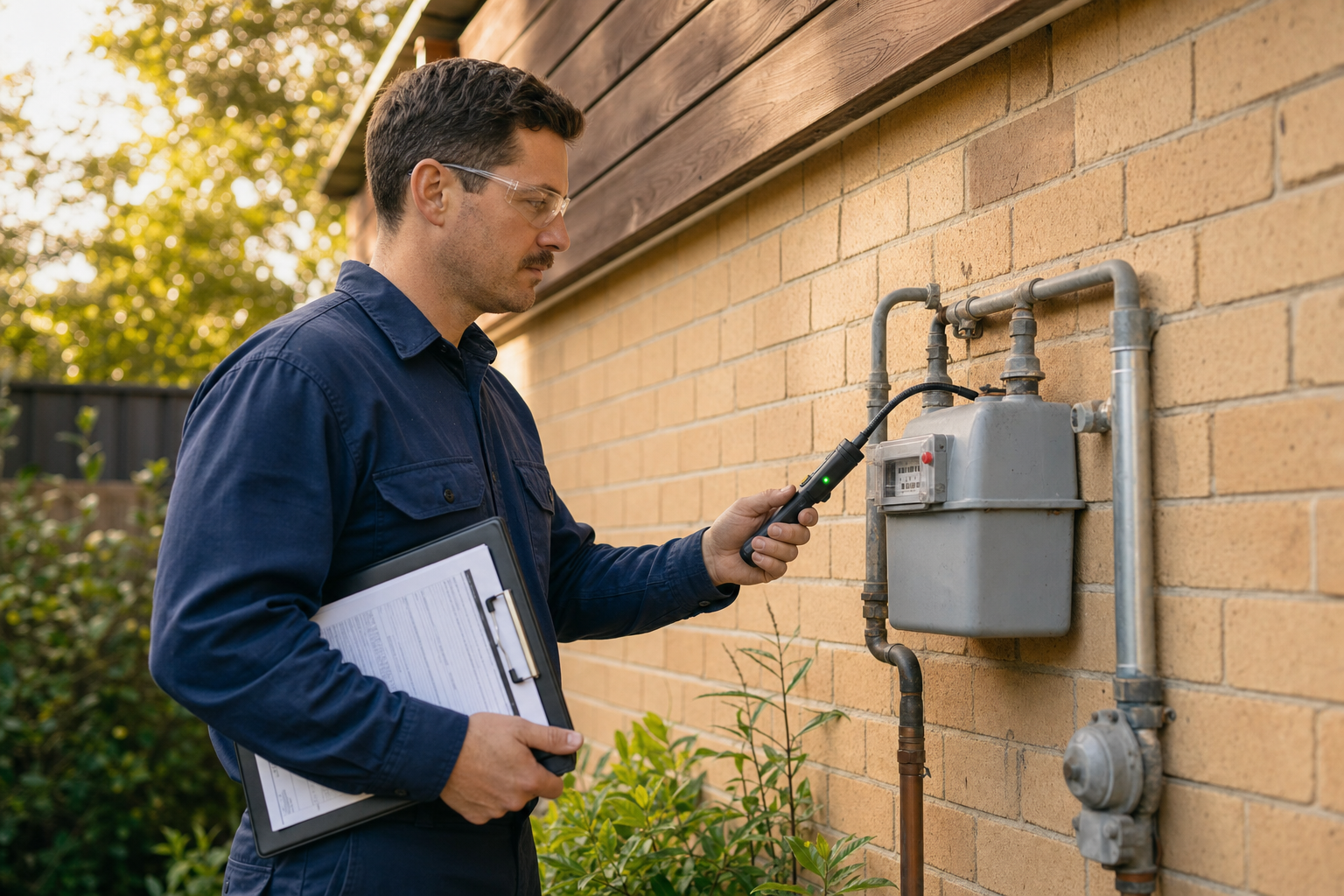
Gas leak emergency response in Sydney

Of all the emergency calls a Sydney plumbing company gets, gas leaks sit at the top of the urgency list. The maths is simple: water damage is expensive but recoverable. A gas leak that finds an ignition source is catastrophic. Treat every gas smell as serious until a licensed gasfitter has confirmed otherwise.

The good news is that most domestic gas leaks across Sydney are at fittings, regulators, or appliance connections — small, localised, and fixable inside an hour once the supply is safe and the source is identified. The hard part is the first 10 minutes, before anyone with the right tools has arrived.

What to do in the first 10 minutes

If you’ve just noticed the smell, work through this sequence in order. Our detailed gas leak emergency guide has the full six-step response — read it now so you’re prepared.

Don’t operate any electrical switches. This includes light switches, ceiling fans, exhaust fans, electric ovens, the doorbell, and your mobile phone (if you can avoid it). Switches generate small sparks that can ignite gas-air mixtures at the right concentration.

Open doors and windows. Cross-ventilation reduces the gas concentration below the lower flammability limit (around 5% for natural gas). Get every external door open if you can do it without operating a powered door.

Get everyone outside. Children, pets, anyone unwell. To the front yard or footpath, well clear of the building. Neighbours too if the smell extends to shared walls or boundaries.

Ring 1800 GAS LEAK from outside. That’s 1800 427 532 — the Jemena Gas Networks emergency line for Sydney. They dispatch a network emergency crew who can isolate supply at the street if needed. This is free; it’s their service obligation as the gas distributor.

If anyone feels unwell, ring 000. Headache, dizziness, nausea, shortness of breath — possible signs of gas exposure. Don’t assume it’ll pass.

Then ring us. Once the area is safe and the network has done their part, you still need a licensed gasfitter to find the source, make the repair, pressure-test, and issue the compliance certificate. That’s where we come in.

Why gasfitting is its own licence in NSW

Under the Gas and Electricity (Consumer Safety) Act 2017, gasfitting work in NSW requires a separate licence to general plumbing. The logic is straightforward: water leaks cause damage; gas leaks cause explosions and asphyxiation. The regulatory framework reflects the risk.

Practical implications for you as a homeowner:

  • A plumber without a current gasfitter’s licence cannot legally touch any gas pipework or fittings, even if they’re qualified to work on the water side of the same hot water unit
  • Insurance claims involving gas work require evidence the work was completed by a licensed gasfitter — usually via a Certificate of Compliance
  • Manufacturer warranties on gas appliances are voided by unlicensed work
  • Selling your home: building inspections by buyers often check for compliance certificates on recent gas work

We hold both plumbing and gasfitting licences, which means a single tradesperson can complete both sides of work involving water and gas (hot water unit replacement, for example) without needing to coordinate two separate trades.

Common Sydney gas leak scenarios

A few patterns we see repeatedly across the metro area.

Corroded outdoor fittings — Eastern Suburbs and Northern Beaches, salt-air zones. Gas regulators, BBQ line connections, and exposed metering fittings corrode within 8-15 years even when properly installed. Symptom: faint outdoor gas smell near the meter or external regulator. Fix: replace the affected fittings with marine- grade equivalents.

Aged regulators on heritage homes — Inner West, Eastern Suburbs heritage zones. Gas regulators in homes that haven’t been renovated since the 1970s often pre-date current safety standards. They fail gradually, with intermittent low-pressure issues at appliances preceding actual leakage. Symptom: appliances starving for gas, pilot lights dropping. Fix: regulator replacement, often combined with a full system pressure test.

Buried line damage from landscaping — across all suburbs. Excavation work for new pools, retaining walls, garden beds, or irrigation often catches the buried gas supply line between the meter and the house. Symptom: gas smell developing days after landscaping work, often near the building. Fix: excavate, replace the damaged section, pressure-test.

Failed appliance connections — across all suburbs. Cooktop flexible gas connectors degrade over 10-15 years (particularly the cheap rubber ones used in 1990s installs). Hot water unit gas valves and pilot assemblies fail with age. Symptoms: smell near the appliance, intermittent failure to ignite. Fix: replace the specific component to manufacturer spec.

Ground subsidence — Western Sydney and parts of the Hills District where reactive clay soils have shifted underground gas lines. Less common than water-line damage from the same cause but more dangerous when it occurs. Symptom: gas smell outdoors with no obvious source above ground. Fix: locate via line tracer, excavate, replace, re-bury to current standard.

Our diagnostic process

Every gas leak call follows the same sequence on arrival:

  1. Confirm the leak with a calibrated electronic gas detector. We carry combustible gas analysers that detect concentrations from 100 ppm. Localises the source to within centimetres.
  2. Isolate the supply at the closest valve — usually the appliance isolation valve or the meter shut-off. Stops the leak while we diagnose.
  3. Pressure-test the whole system to AS/NZS 5601 standard. Reveals any secondary leaks beyond the obvious one.
  4. Quote the repair in writing with parts and labour breakdown. Even at 3am. You approve before any work starts.
  5. Complete the repair using certified materials and joint compound. Torque-tested to manufacturer specification.
  6. Re-pressure-test the affected section. Hold pressure for at least 5 minutes; verify with electronic detector at every fitting.
  7. Issue the Certificate of Compliance documenting the work, materials used, and test results. Hand over before turning supply back on.
  8. Re-light pilot lights on connected appliances; verify each appliance is operating normally before we leave.

Working with Jemena Gas Networks

Jemena owns and operates the natural gas distribution network across most of Sydney. Practical implications when an emergency happens:

  • The supply line before your meter is Jemena’s responsibility
  • The supply line after your meter is your responsibility
  • Their emergency response is free and obligatory
  • They will not perform any work after the meter — that’s licensed gasfitter territory

In about 15% of emergency gas calls we attend, the leak turns out to be on the network side (street main, supply-line corrosion, regulator on the meter itself). When that happens, we coordinate the handover — Jemena’s crew handles the network repair, we handle any consequent work on your side of the meter, and the compliance documentation is combined.

Annual gas safety inspections

Worth flagging because most Sydney homeowners don’t realise it’s recommended: an annual gas safety inspection by a licensed gasfitter is the single best preventative measure against emergency calls.

Costs about $180-280 for a full inspection covering:

  • Meter and regulator condition
  • Visible pipework integrity (above-ground sections)
  • Appliance connections and isolation valves
  • Combustion analysis on hot water units and gas heaters
  • Pressure-hold test on the whole system

Most failed regulators and corroded fittings we end up replacing on emergency calls were already showing signs of impending failure 12-18 months earlier. Annual inspection catches them before the smell-of-gas moment.

Strata buildings in Sydney are increasingly mandating annual gas inspections through their bylaws — particularly newer high-rises in Pyrmont, Surry Hills, and Bondi Junction. Worth checking your strata schedule if you’re in an apartment.

To understand licensing requirements before you call, read our guide on how to verify a NSW plumber’s licence. For cost estimates, see our emergency plumber pricing guide.

Our process

From quote to repair — four clear steps

Repair workflow

Gas Leak Emergency Sydney

  1. 1

    Step 1

    Make safe on arrival

    First action — confirm the location of the leak with a calibrated detector, isolate the gas supply at the meter or appliance, ventilate the affected area.

  2. 2

    Step 2

    Diagnose the source

    Most leaks are at fittings, regulators, or appliance connections. We pressure-test the line to identify exactly which section needs repair.

  3. 3

    Step 3

    Repair to AS/NZS 5601

    Replacement fittings, certified pipe and joint compound, torque-tested to spec. Every repair documented for the compliance certificate.

  4. 4

    Step 4

    Certify and re-test

    Pressure-hold test for at least 5 minutes, leak-test every fitting with electronic detector, issue compliance certificate and turn the supply back on.

Every job: 12-month workmanship guarantee · NSW Fair Trading licensed · $20M public liability cover

Real Sydney rates

What you can expect to pay

Honest pricing based on actual Sydney market rates. Final quote always confirmed in writing before any work begins — no hidden call-out tricks.

Job typeSydney range (AUD)
Emergency call-out + leak detection$220-380
Single fitting / appliance connection repair$280-550
Section pipe replacement (above ground)$450-1,200
Gas regulator replacement$350-700
Buried gas line repair / replacement$1,200-3,500
Annual gas safety inspection$180-280

Ranges reflect typical Sydney metropolitan area pricing for 2026. Standard hourly: AUD 120-160. After hours / weekends: AUD 180-300.

Where we cover

Gas Leak Emergency Sydney — by Sydney area

Same service, same prices, all Sydney metropolitan suburbs. Some regions have local quirks worth knowing about — tap your area below.

What customers say about this service

Recent gas leak emergency sydney reviews

4.9/5 from 53 reviews

Janet H.

Chatswood

"Smelt gas near the cooktop at 6am. Rang Jemena first as advised on the website — they made it safe by 7. Plumber arrived 7:45, found a corroded fitting at the regulator, replaced it, pressure-tested, certificate in hand by 9. Felt safe the whole time."
06/04/2026

Marco D.

Leichhardt

"Old gas heater wouldn't fire — pilot kept dropping. Turned out the regulator on the wall was original to the 1968 build and had failed. Replaced, certified, all good. Recommended a full appliance inspection while there. Honest, no pressure."
19/03/2026

Sue R.

Castle Hill

"Buried gas line damaged when we had landscapers in. Smelt gas in the laundry next morning. Excavated and replaced about 4 metres of line, full compliance, dealt with the insurance claim from the landscaper for me. First-class service."
11/02/2026

Liam B.

Penrith

"BBQ gas line was hissing. Diagnosed and replaced the fitting, certified it. Standard rate. Took longer than I expected but the work was thorough — pressure-tested every fitting on the system not just the failed one."
23/12/2025

Common questions

Gas Leak Emergency Sydney — your questions answered

  • What should I do RIGHT NOW if I smell gas?
    Don't operate any electrical switches (lights, fans, phones) — they can spark and ignite a leak. Open doors and windows, get everyone outside, then ring 1800 GAS LEAK (1800 427 532, the Jemena Gas Networks emergency line). They make the supply safe at the network level. Once the area's safe, ring us for the repair and compliance certificate. If anyone feels unwell, ring 000.
  • Is the smell of gas always dangerous?
    Yes — treat every gas smell as serious. Natural gas is odourless naturally; the rotten-egg smell is added (mercaptan) specifically so leaks are detectable. A faint smell near a stove or hot water unit might be a small fitting leak; a strong smell anywhere is a genuine emergency. Don't wait it out, don't try to find the source yourself with a lighter (people still do this — never).
  • Why do plumbers and gasfitters have separate licences in NSW?
    Under the NSW Gas and Electricity (Consumer Safety) Act 2017, gasfitting is regulated separately from plumbing because of the higher safety risk. A plumber without a current gasfitter's licence can legally work on water pipes but commits an offence by touching a gas line. Most plumbing companies hold one licence or the other; we hold both, which means a single tradesperson can complete both sides of a hot water system replacement, for example.
  • What's a compliance certificate and do I need one?
    A Certificate of Compliance is a document issued by a licensed gasfitter confirming that gas work has been completed to AS/NZS 5601 standard. It's required by NSW law for any new gas install or significant repair. Practical importance: home insurance claims involving gas appliances often require a current compliance certificate as evidence of legal install. We issue them on the spot at job completion.
  • Can I smell gas outside near the meter — is that the same urgency?
    Yes, treat it the same. Gas smells outside often indicate a leak at the regulator or the buried supply line between the meter and the house — both serious. Ring 1800 GAS LEAK first; they may need to do supply-side work before we can complete the repair. Stay back from the area; don't smoke; don't operate vehicles within 10 metres.
  • How much does it actually cost to fix a small gas leak?
    Most small fitting leaks (a corroded connector at the cooktop, a worn regulator on a hot water unit) cost $280-550 to diagnose and repair, including the compliance certificate. Larger jobs (buried line replacement, multiple-fitting failures) range higher. We'll always pressure-test the whole system before signing off — sometimes one obvious leak turns out to share a system with a second small leak that's worth fixing while we're there.
  • What about gas appliances — do you service those too?
    Yes. Cooktop and oven gas connections, hot water unit gas valves and pilot assemblies, gas heater servicing, BBQ gas line connections (where they tee off the main supply). Anything downstream of the meter and connected to the gas supply is gasfitter territory. Major appliance repair (electronics, fan motors) usually falls to brand-specific service techs but we coordinate where useful.

Need a gas leak emergency sydney now?

Get a free Sydney quote in under 60 seconds.

Our licensed Sydney plumbers are on call 24/7. Tell us your suburb and we'll be in touch within 15 minutes with a quote and ETA.